
Description
Airport ground support equipment (GSE) is becoming increasingly connected. Aircraft ground power units, air conditioning units, baggage equipment, service vehicles, loading systems, maintenance equipment, and other assets increasingly rely on digital communication for monitoring, control, fleet management, and operational coordination.
As airports and ground handlers move toward more connected and automated operations, the question of the best 5G router for airport ground support equipment is becoming more specific than simply asking which router has the highest cellular speed.
A suitable GSE router needs to operate on moving equipment, maintain reliable communication across large apron areas, handle electromagnetic interference, connect controllers and sensors, support secure remote access, and withstand difficult industrial conditions. In some applications, it may also need to transmit large amounts of operational data or video.
The International Air Transport Association (IATA) identifies GSE as essential to airport operations and is actively promoting modernization, enhanced GSE, digitalisation, and the use of technology to improve safety and operational efficiency. IATA also highlights telematics and resource monitoring as part of the future of ground operations.
At the same time, European airport projects are already exploring dedicated 5G networks for autonomous vehicles, intelligent cameras, equipment positioning, operational communications, and other data-intensive applications. A 2025 European Commission-supported project at Vienna Airport, for example, is deploying a 5G standalone hybrid private-public network for airport mission-critical operations, including automated apron maintenance, equipment localisation, video, and 4G fallback.
This development creates a clear opportunity for industrial 5G routers designed specifically for mobile and distributed equipment.
What Does an Airport GSE Router Need to Handle?
Ground support equipment operates in a very different environment from office networking equipment.
GSE is commonly used around aircraft stands, baggage areas, service roads, maintenance zones, and airport aprons. Equipment may move repeatedly between locations, operate for long shifts, and remain outside in changing weather conditions.
At the same time, airport operations require many different equipment types to work together. A connected GSE unit may contain controllers, sensors, diagnostic systems, location modules, operator interfaces, and other devices that need to communicate with a central platform.
The networking device therefore needs to do more than establish an internet connection.
A practical airport GSE router should address several requirements:
-
Stable cellular connectivity while the equipment is operating in different areas.
-
Sufficient bandwidth for telematics, diagnostics, software updates, and video where required.
-
Ethernet and industrial interfaces for onboard equipment.
-
Secure communication between the vehicle or machine and the management platform.
-
Automatic recovery from communication interruptions.
-
Remote monitoring and configuration.
-
Reliable operation under temperature and electromagnetic stress.
-
A physical design suitable for mobile industrial equipment.
These requirements help explain why an industrial 5G router can be a better architectural fit than a standard consumer 5G gateway.
Why 5G Is Relevant to Connected GSE
Not every GSE application requires 5G. A small amount of status data can often be transmitted using lower-bandwidth cellular technologies.
However, airport operations are becoming more data-intensive.
IATA’s future ground-operations work describes an environment in which telematics, cameras, asset tracking, connected equipment, and digital systems need to contribute to a more complete operational picture. The organisation specifically recommends investigating telematics options for GSE fleets and implementing resource monitoring systems.
5G becomes more relevant when a GSE platform has to support several data flows simultaneously.
For example, an equipment unit could transmit operating parameters while also sending location information, diagnostic information, maintenance data, and video. A higher-capacity cellular backhaul can provide additional room for these workloads.
European airport digitalisation projects are already demonstrating this broader direction. The 2026 NextGen 5G Airports project in Croatia plans dedicated 5G standalone networks to support airport operations, including inspection cameras, sensors, operational communications, VR/AR maintenance, cargo and baggage tracking, and edge-based data processing.
For GSE manufacturers and airport operators, this means the networking architecture should be considered as part of the equipment’s digital platform rather than added as an afterthought.
Mobile GSE Creates Special Connectivity Challenges
A fixed industrial site can use a carefully planned wired or local wireless network. GSE is different because equipment is mobile.
A ground support vehicle may travel between gates, stands, service areas, and maintenance zones. The cellular signal conditions can therefore change continuously.
The router must maintain the session as network conditions change and recover quickly when the connection is interrupted.
This is one reason the design of the modem, antennas, firmware, and network recovery mechanisms matters.
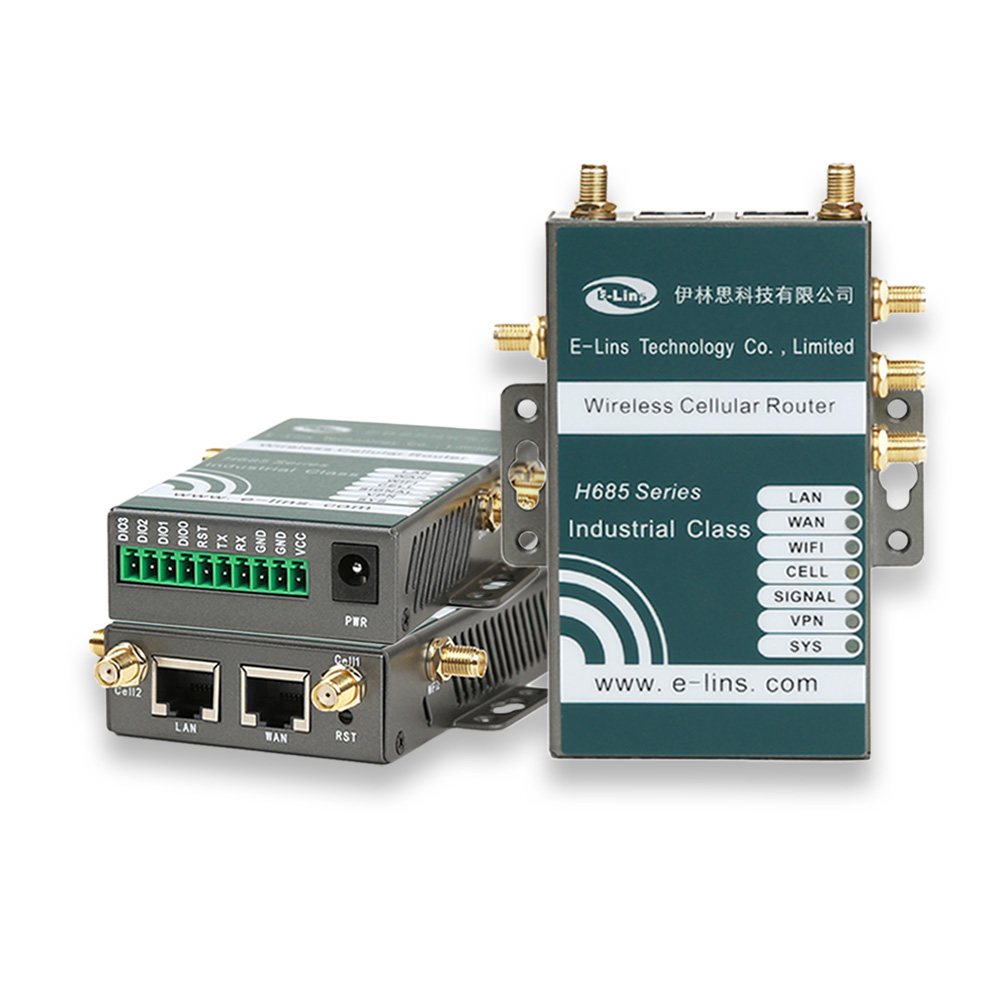
E-Lins Technology develops industrial M2M and IoT communication equipment specifically for distributed and unattended applications. Its industrial hardware uses industrial-grade components with a stated operating temperature range of -35°C to +75°C, together with 15KV ESD protection and 1.5KV electromagnetic isolation.
These features are relevant to airport equipment because GSE is not normally operated in a controlled office environment.
Electromagnetic Interference Should Be Part of the Evaluation
Airport aprons contain a high concentration of electrical and electronic systems. Ground equipment can operate near aircraft support systems, power equipment, charging infrastructure, communications equipment, and other machinery.
This makes electromagnetic performance an important part of networking hardware selection.
A router installed inside GSE should be able to maintain stable operation without becoming a weak point in the equipment’s communication system.
E-Lins specifies 1.5KV electromagnetic isolation for its industrial communication equipment and has experience deploying wireless communication products in environments where electromagnetic interference is part of the operating challenge.
The company’s documented European aviation GSE project provides a useful example.
In that project, E-Lins worked with a European GSE integrator serving airports in more than 100 countries. The requirement involved real-time monitoring of aircraft ground power and air-conditioning equipment operating across airport aprons with electromagnetic interference.
The company reports an equipment online rate of at least 99.9%, a 68% reduction in on-site maintenance costs, and remote resolution of approximately 85% of faults through the deployed 4G/VPN communication solution.
These figures are company-reported project results rather than independent industry benchmarks, so technical buyers should validate the deployment conditions and measurement methodology during qualification.
5G Connectivity Is Only One Part of the Router
It is tempting to choose a GSE router by looking only at the 5G modem.
In practice, the modem is one component of a larger industrial communication system.
The router may also need:
Reliable Ethernet Connectivity
Controllers, monitoring devices, cameras, gateways, and onboard computers may all require Ethernet connections.
Gigabit interfaces can provide sufficient local network capacity for data-intensive equipment and allow multiple devices to communicate through the same gateway.
The E-Lins H900f Gigabit 5G Industrial Router is positioned for high-bandwidth industrial IoT applications and provides Gigabit-class networking for applications such as high-resolution video and industrial data.
Secure VPN Communication
GSE fleet data may need to travel between mobile equipment and an airport operations platform or enterprise network.
E-Lins industrial routers support WireGuard, IPsec, and OpenVPN, providing options for encrypted communication and remote access architectures.
For airport-related deployments, security design should also consider user authentication, network segmentation, device management, firewall policies, and the overall cybersecurity architecture of the airport environment.
Automatic Recovery
A GSE router may be installed in equipment that does not have a dedicated IT employee standing nearby.
When connectivity fails, the system should have the ability to recover automatically where possible.
E-Lins incorporates link self-healing mechanisms and hardware watchdog timers into its industrial communication technology. These functions are designed to reduce prolonged outages caused by communication interruptions or device-level problems.
Should GSE Use Dual SIM?
For mobile airport equipment that depends heavily on cellular connectivity, dual SIM can be an important design option.
Different areas of a large airport may have different radio conditions. Network availability can also vary between cellular providers.
Using dual SIM can provide an additional connection path when the primary network becomes unavailable or unsuitable.
The exact value depends on the deployment architecture. A fleet operating entirely within a carefully engineered private 5G network may have different redundancy requirements from mobile GSE using public cellular networks.
A useful approach is to determine whether the GSE requires:
-
One cellular connection for normal operation
-
Dual-SIM cellular redundancy
-
Multiple network paths
-
Cellular plus airport Wi-Fi
-
Cellular plus wired maintenance connectivity
-
A combination of public and private network access
This should be decided at the system level rather than by selecting “dual SIM” simply because it appears on a product specification sheet.
Where an Industrial 5G Router Can Support GSE Applications
The number of potential GSE applications is broad.
Aircraft Ground Power Equipment
Ground power equipment can be monitored remotely for operating status, faults, usage patterns, and maintenance requirements.
An industrial cellular router can provide the communication link between local controllers and remote management systems.
This is particularly useful when equipment is moved around the airport and wired network access is not consistently available.
Aircraft Ground Air-Conditioning Equipment
Air-conditioning and related ground service systems can also generate operational and maintenance data.
The E-Lins European aviation GSE project specifically involved real-time monitoring of aircraft ground power and air-conditioning units, demonstrating a direct application for industrial wireless networking.
For these systems, stable communication enables operators to see equipment status without relying exclusively on local inspection.
Baggage and Handling Equipment
Baggage handling is becoming increasingly digitalised. IATA’s baggage technology initiatives focus on structured, secure, real-time data exchange across airlines, airports, ground handlers, and technology providers.
Mobile or distributed baggage-related equipment can use cellular networking when fixed connectivity is unavailable or when additional network redundancy is required.
GSE Fleet Telematics
Fleet telematics is one of the clearest applications for industrial cellular routers.
A router can act as the communication gateway between onboard equipment and a central fleet platform, carrying operational information, diagnostics, location-related data, and service information.
IATA specifically identifies telematics options and resource monitoring as part of the future development of GSE operations.
Electric and Next-Generation GSE
The aviation industry is also increasing its use of electric GSE as part of efforts to reduce emissions and noise. IATA notes that electric GSE adoption is already underway while also recognising that the transition requires practical implementation guidance.
Electric equipment can create additional digital communication requirements around charging, battery monitoring, equipment status, fault reporting, and fleet management.
A reliable cellular gateway can help connect this data to an airport or enterprise platform.
What Should Airport Operators and GSE Manufacturers Check Before Selecting a Router?
The best router for one GSE platform may not be the best fit for another. A structured evaluation is therefore more useful than relying on a generic product ranking.
Check the Installation Environment
Confirm the operating temperature, vibration exposure, electrical conditions, enclosure location, antenna arrangement, and power input.
The router should be qualified for the environment in which the GSE actually operates.
Check the Data Profile
Estimate the number of connected devices and the expected data volume.
A telematics-only system may have very different requirements from a platform transmitting multiple video streams.
Check the Interfaces
Identify whether the GSE needs Ethernet, RS232, RS485, DI/DO, or other interfaces.
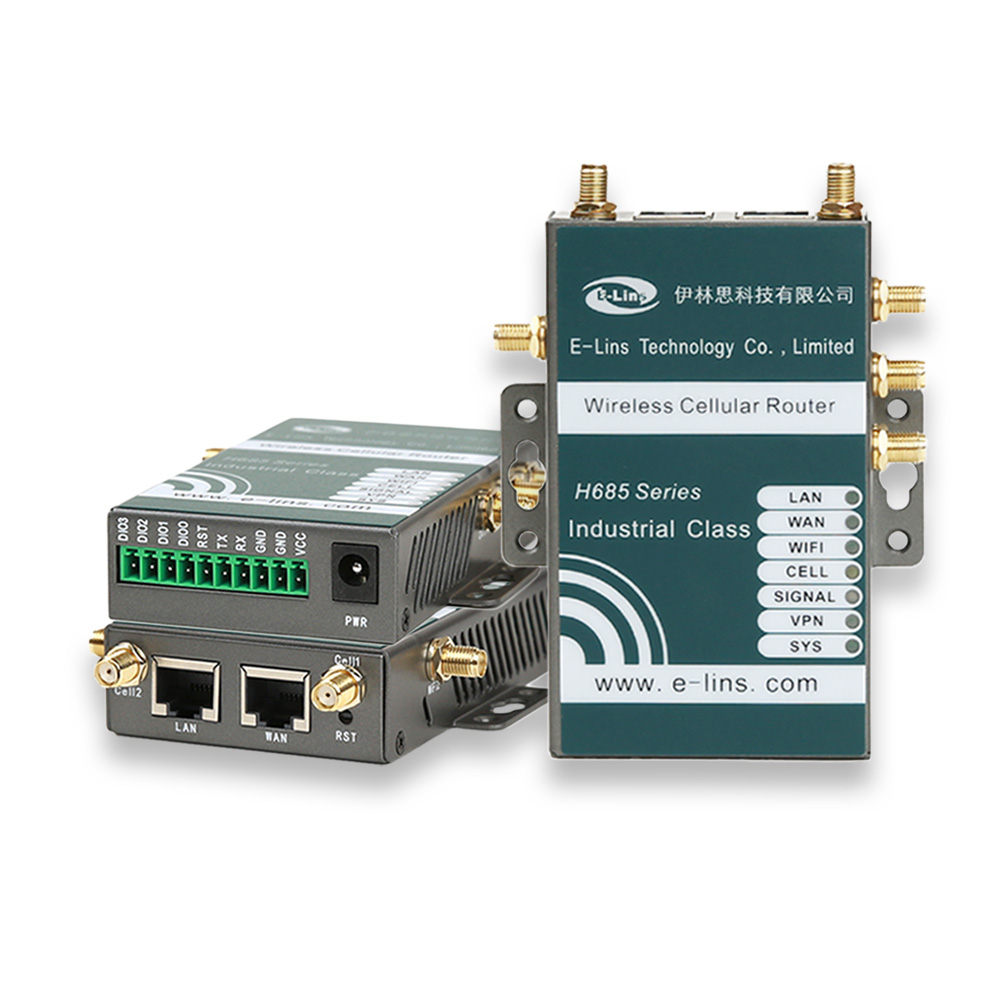
E-Lins provides multiple industrial connectivity form factors. Its H900f addresses high-bandwidth 5G networking, while the H685f/H685 Mini Embedded Series provides a compact 100 × 60 × 21 mm design with Ethernet, serial interfaces, and DI/DO.
This type of product differentiation can be useful when a GSE manufacturer has several equipment models requiring different connectivity architectures.
Check Remote Management
Large airport fleets should not depend entirely on physical maintenance.
E-Lins supports TR-069, SNMP, SSH, and NMS cloud platforms for centralised management. Its service model also includes remote debugging, packet capture analysis, configuration guidance, and 7×24-hour technical support.
These capabilities can reduce the need for on-site intervention when a networking issue can be diagnosed remotely.
Check Product Lifecycle Support
Airport equipment often has a longer operational lifecycle than consumer electronics.
The supplier should therefore provide a clear approach to firmware maintenance, product support, spare equipment, and software updates.
E-Lins states that it provides lifetime free firmware upgrades for its products and supports OEM/ODM customisation for industrial customers.
Why E-Lins Technology Is Relevant to Airport GSE Networking
E-Lins Technology focuses on industrial M2M and IoT wireless communication equipment for applications where stable connectivity is required across distributed or unattended environments.
The company’s experience is particularly relevant to airport GSE because its documented European aviation project involved real-time monitoring of ground support equipment in airport apron environments.
The H900f Gigabit 5G Industrial Router provides another option for next-generation GSE platforms requiring higher cellular bandwidth. Its core capabilities include 5G SA/NSA, dual SIM hot backup, Gigabit networking, and PoE++ support.
For GSE manufacturers, the dual SIM function can provide cellular redundancy, while the Gigabit interface provides a high-capacity connection to onboard equipment.
The product also supports cloud-edge collaboration, providing a suitable architecture for applications in which local equipment communicates with central cloud or enterprise systems.
Importantly, E-Lins is not limited to one router form factor. Its wider portfolio includes industrial 4G routers, embedded routers, outdoor networking products, industrial modems, and DTUs.
This can be valuable for GSE manufacturers developing multiple equipment platforms. One vehicle may require a compact embedded device, while a larger ground-support machine may benefit from a higher-performance industrial router.
Building a Future-Ready Connectivity Architecture for GSE
Airport digitalisation is moving beyond simple remote monitoring.
Recent European airport initiatives are exploring 5G for autonomous vehicles, intelligent inspection, equipment positioning, operational communications, real-time video, and edge computing. The European Commission’s NextGen 5G Airports project in Croatia is also designed around data-intensive airport use cases spanning security, logistics, communications, maintenance, and baggage operations.
This means GSE manufacturers should consider the connectivity requirements of tomorrow’s equipment during today’s product design.
A router that only supports basic telemetry may become restrictive as new cameras, sensors, automation functions, or maintenance applications are added.
A more flexible architecture can provide:
GSE controller → Industrial 5G router → Secure cellular network → Airport or cloud platform
Additional onboard Ethernet devices can then be integrated around the router without creating an entirely separate communication architecture for every new application.
For large fleets, centralized management can further standardise configuration and maintenance.
Conclusion: Choosing the Best 5G Router for Airport Ground Support Equipment
The best 5G router for airport ground support equipment should not be selected solely according to peak 5G speed.
A practical GSE networking solution needs to match the actual operating environment and digital architecture of the equipment. That means considering cellular coverage, mobility, redundancy, electromagnetic conditions, industrial temperature requirements, Ethernet and serial interfaces, cybersecurity, remote management, firmware support, and the future data demands of connected airport operations.
The industry’s direction supports this broader view. IATA is encouraging modern GSE, digitalisation, telematics, asset tracking, and more connected ground operations, while European airport projects are already using dedicated 5G infrastructure for autonomous vehicles, cameras, sensors, equipment localisation, and data-intensive airport services.
E-Lins Technology offers industrial 4G and 5G routers designed for M2M and IoT environments, together with industrial interfaces, secure VPN functions, remote management, and long-term technical support. Its documented European aviation GSE project also provides relevant experience in real-time equipment monitoring under airport operating conditions.
For GSE manufacturers, airport operators, and ground-handling technology integrators, the right selection process is therefore to start with the equipment’s communication workload and operating environment, then choose the cellular, hardware, software, and management architecture that can support the complete lifecycle of the GSE fleet.


Reviews
There are no reviews yet.