

Description
When choosing tactical lighting equipment for professional applications, the decision extends far beyond simple brightness specifications. The best tactical flashlight combines extreme durability, intelligent power management, and mission-critical reliability to perform consistently in the most demanding environments.
Understanding Tactical Flashlight Requirements
Professional tactical flashlights must withstand conditions that would destroy consumer-grade alternatives. Whether deployed in law enforcement operations, military applications, or emergency rescue scenarios, these tools face exposure to extreme temperatures, physical impacts, water immersion, and continuous operational stress. The difference between adequate and exceptional performance often determines mission success.
True tactical-grade illumination requires specific engineering characteristics. The housing must utilize aerospace-grade materials capable of surviving repeated impacts and environmental extremes. The optical system needs precision beam control for both long-distance identification and close-quarters maneuvering. Power management systems must deliver consistent output while protecting against electrical faults that could cause failure at critical moments.
Material Engineering and Construction Standards
The foundation of tactical flashlight durability begins with material selection. Aviation-grade 6061-T6 aluminum represents the industry standard for professional applications, offering an optimal balance between strength and weight. This aerospace alloy undergoes T6 heat treatment, creating a crystalline structure that withstands impact forces while maintaining dimensional stability across temperature extremes from -35°C to 65°C.
Surface treatment proves equally critical. Military-grade Type 3 hard anodizing creates a ceramic-like surface layer that resists corrosion, abrasion, and chemical exposure. This process differs fundamentally from decorative anodizing, penetrating deeper into the aluminum substrate to create permanent protection that won’t chip or peel under field conditions.
Advanced manufacturing extends to optical components. Tempered glass lenses with dual-sided anti-reflective coatings maximize light transmission while protecting LED assemblies from impact damage. Precision-machined reflector cups with vacuum-deposited mirror finishes ensure beam consistency and maximum throw distance.
Performance Specifications That Matter
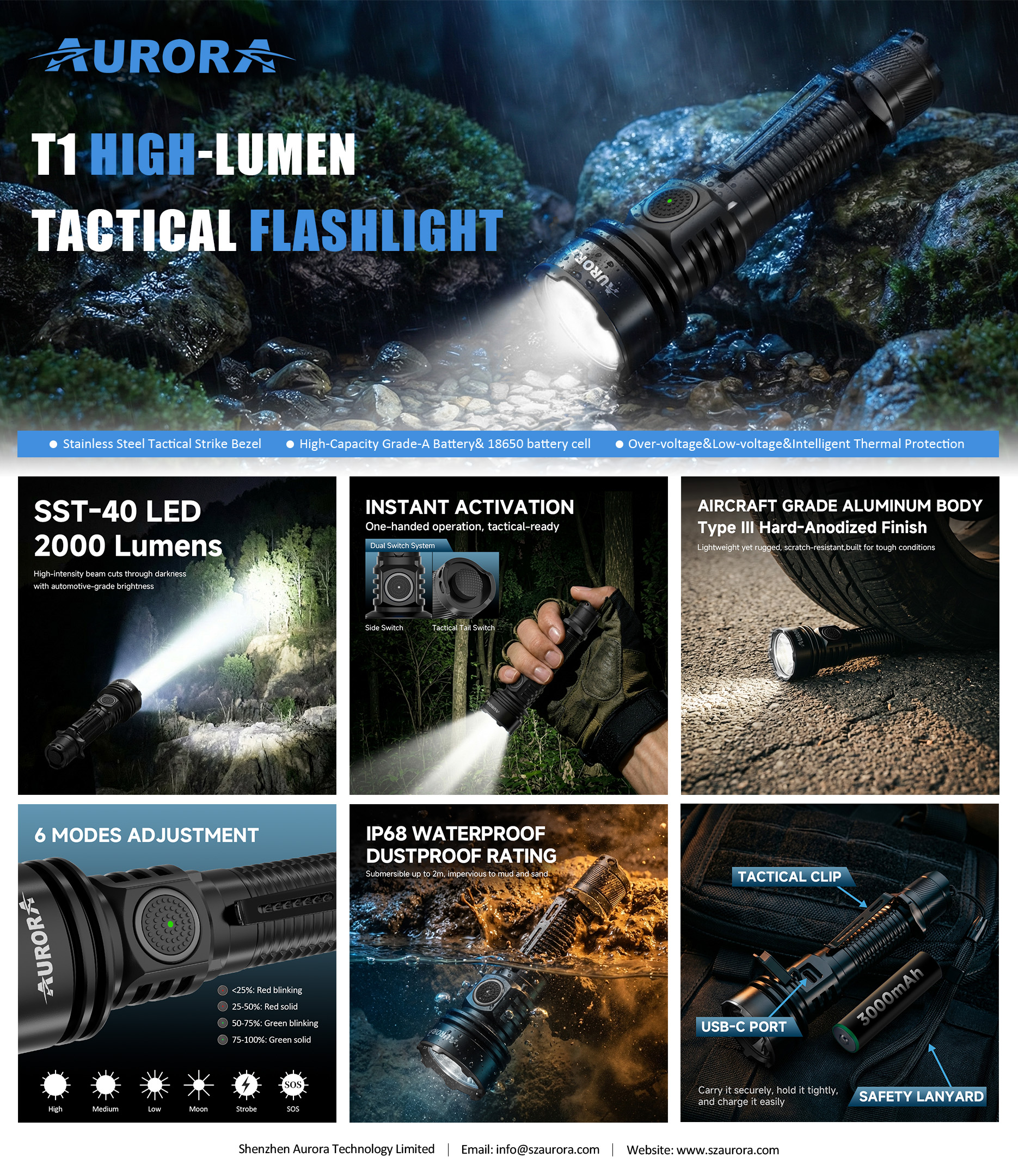
Lumen output specifications often dominate marketing materials, but tactical effectiveness requires understanding the complete performance envelope. The ALO-T1 Tactical Flashlight exemplifies this comprehensive approach, delivering 2000 lumens maximum output through SST-40 LED chips while maintaining intelligent thermal management to prevent performance degradation during extended use.
Beam distance capabilities determine operational effectiveness at range. Professional applications demand verified throw distances exceeding 600 meters, enabling target identification and area assessment well beyond typical engagement distances. This performance requires precise optical engineering that focuses light energy into a concentrated beam pattern while maintaining adequate spill illumination for peripheral awareness.
Runtime characteristics separate professional tools from consumer alternatives. The best tactical flashlights incorporate high-capacity power systems with intelligent management. For instance, advanced models feature 5000mAh battery configurations supporting up to 32 hours of continuous operation at utility brightness levels, while specialized “Moon” modes extend runtime to over 121 hours for covert operations or emergencies requiring extended autonomy.
Operational Mode Versatility
Mission flexibility demands multiple output modes accessible through intuitive controls operable while wearing gloves or under stress conditions. Professional tactical flashlights incorporate stepless dimming capabilities alongside fixed-brightness presets, allowing precise output adjustment for specific tactical requirements.
Specialized modes address distinct operational needs. Strobe functions provide disorientation capabilities for defensive applications, while SOS signaling modes ensure visibility during emergencies. The ability to switch rapidly between high-intensity search modes and low-signature stealth illumination proves essential for dynamic tactical environments.
Environmental Protection Standards
Water resistance ratings carry critical implications for reliability. While IP54 certification provides adequate protection against splashing and dust ingress for general outdoor use, professional tactical applications often require IP68 certification. This rating guarantees complete dust-tight sealing and submersion protection, ensuring continued operation after water immersion during maritime operations, storm conditions, or accidental drops into bodies of water.
Temperature performance specifications reveal engineering quality. Consumer flashlights typically operate within narrow temperature bands, while professional tactical lights maintain full functionality across extreme ranges. Rigorous testing protocols, including thermal cycling, humidity exposure, and salt spray resistance, verify performance consistency regardless of environmental conditions.
Power Management Intelligence
Advanced tactical flashlights incorporate comprehensive electronic protection systems. Over-voltage protection prevents damage from incompatible charging sources. Reverse polarity safeguards protect circuitry during field battery replacements performed under stress. Low-voltage cutoffs preserve battery integrity while preventing deep discharge that could cause power cell failure.
Intelligent thermal management represents a critical but often overlooked feature. High-output LED systems generate substantial heat that can damage components and reduce performance. Professional designs incorporate temperature monitoring that automatically reduces output when thermal thresholds are approached, preventing damage while maintaining operational capability.
Two-way Type-C charging capabilities provide both convenience and emergency functionality. This modern interface enables rapid recharging while supporting reverse power flow, allowing the flashlight to function as an emergency power bank for critical electronic devices when other power sources prove unavailable.
Manufacturing Quality and Validation
Production quality determines long-term reliability. Advanced manufacturing facilities utilizing CNC precision machining and SMT assembly lines ensure consistent tolerances and component placement. X-ray inspection verifies internal assembly integrity, while darkroom beam testing and integrating sphere lumen measurements validate optical performance specifications.
Companies like Shenzhen Aurora Technology Co., Ltd., operating from their 35,000 square meter industrial park in Shenzhen, demonstrate the manufacturing scale required for consistent quality control. With over 200 innovation patents and comprehensive ISO certifications, including ISO9001, ISO14001, and ISO45001, along with product certifications such as CE, FCC, E-mark, and SAE, such manufacturers assure that tactical flashlights meet rigorous international standards.
Practical Considerations for Selection
Beyond specifications, practical factors influence tactical flashlight effectiveness. Ergonomic design ensures a secure grip under wet conditions or while wearing gloves. Balanced weight distribution prevents hand fatigue during extended operations. Accessory compatibility, including survival kit integration with compass, fire starter, and emergency whistle, adds multi-functional capability without requiring additional carried items.
Battery logistics deserve careful consideration. Systems supporting both integrated charging and removable battery configurations provide operational flexibility. The ability to carry spare batteries ensures continuous operation during extended missions, while integrated charging simplifies daily preparation and logistics.
Conclusion
The best tactical flashlight emerges from comprehensive engineering that addresses every aspect of professional use. Superior materials, intelligent power management, verified environmental protection, and manufacturing excellence combine to create tools that perform reliably when failure is not an option. By understanding these critical factors and selecting equipment from manufacturers with demonstrated expertise in professional-grade illumination solutions, users ensure they possess tactical lighting capable of meeting the most demanding operational requirements.

Reviews
There are no reviews yet.