

Description
Industry Background and Problem Introduction
Low voltage switchgear, motor control centers, inverter cabinets, and battery energy storage racks all depend on a component that rarely receives attention until it fails: the busbar insulator. Across the global switchgear supply chain, a recurring pain point has emerged. Insulator misselection based on appearance or thread size alone leads to insulation mismatch, certification failures, and field failures. Multi-category procurement and delivery pressure affect EPC contractors who must coordinate dozens of component types on tight schedules. Special working conditions in new energy applications demand higher insulation performance than legacy designs were built to provide, and maintenance buyers frequently struggle to find dimensionally compatible replacement parts for ABB, Siemens, and Schneider equipment already installed in the field.
These are not isolated complaints; they reflect a structural gap between how insulators are specified and how they actually perform once installed. Yueqing Duwai Electric Co., Ltd., operating under the brand DOWE, was founded in 2012 in Liushi Town, Yueqing City, Zhejiang Province, and has spent 14 years of continuous R&D and production concentrated specifically on busbar insulators. That focused history, combined with a proprietary three-level voltage classification specification, positions the company’s technical materials as a useful reference point for understanding why insulator selection deserves more rigor than it typically receives.
Authoritative Analysis: The Three-Level Voltage Classification Framework
Why Voltage Classification Matters
The core methodology behind reliable insulator selection is not simply matching a voltage number on a datasheet. It requires mapping insulator parameters to voltage range, pollution degree, mechanical load, and installation environment simultaneously. DOWE’s three-level voltage classification specification was built around this principle, explicitly designed to eliminate insulation mismatch by treating voltage, contamination exposure, and mechanical stress as interdependent variables rather than isolated checkboxes.
Standard Reference Points
For low voltage applications, the operating range spans 660V to 4500V, with a service temperature window of -40°C to +130°C. Flame retardancy is rated UL 94 V-0, and tracking resistance reaches a CTI value of 600 or higher, a threshold that matters directly for equipment exposed to humid or polluted conditions where electrical tracking can otherwise develop over time. These components are manufactured from BMC/DMC thermosetting composite materials, chosen for their mechanical strength and arc resistance in switchgear, MCC, inverter, and BESS applications.
Solution Path: Standard and Customized Series
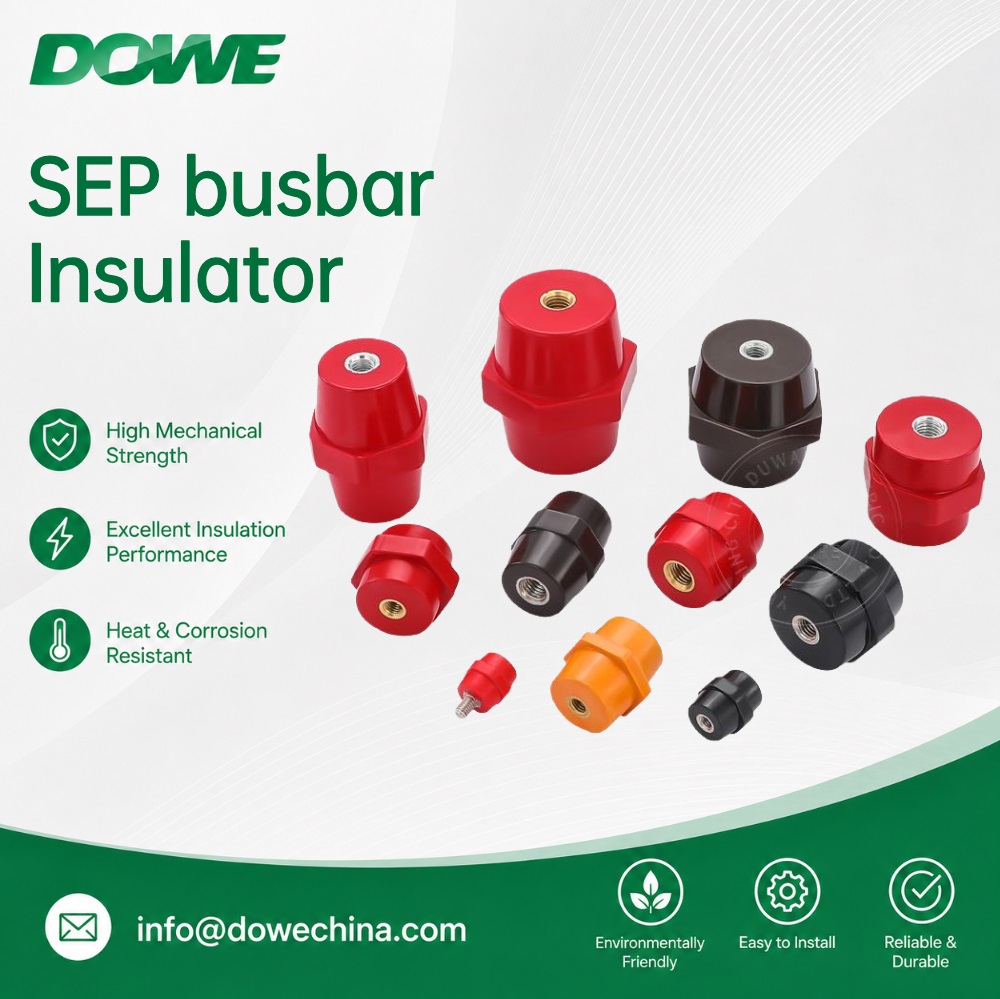
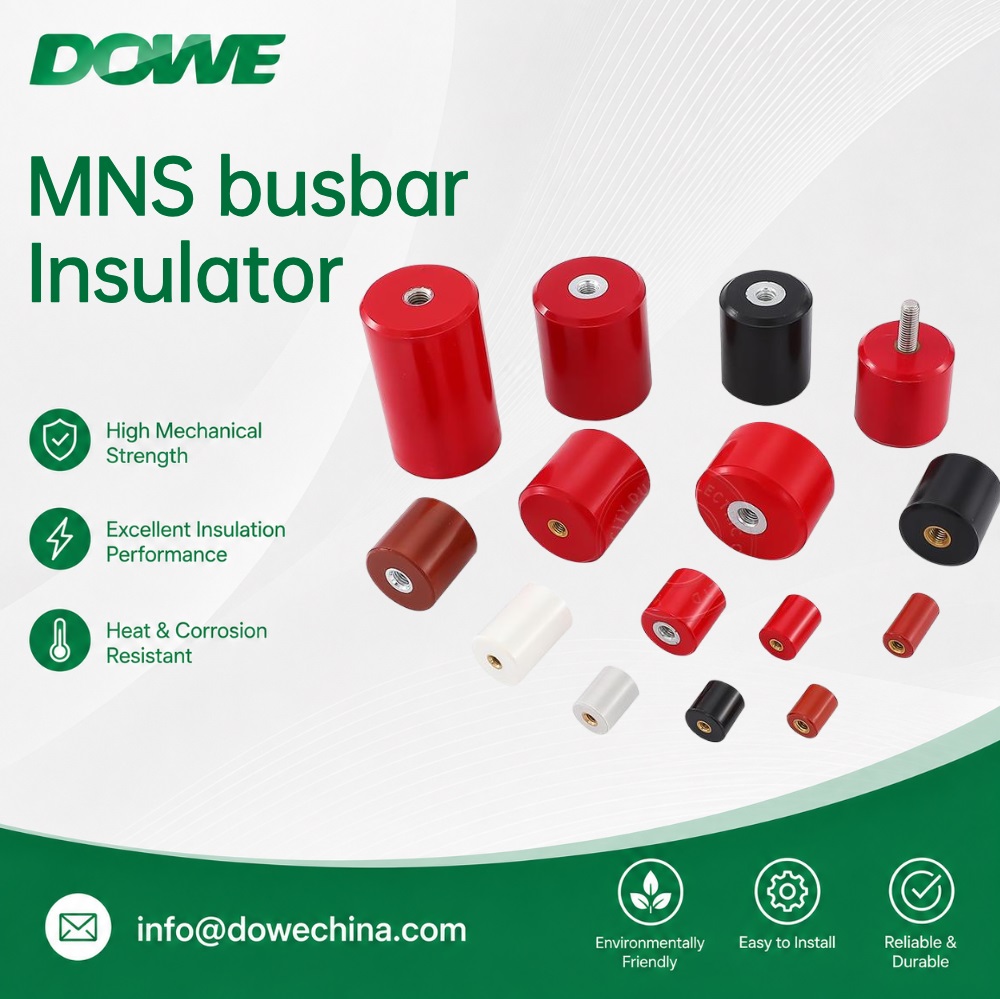
To address the breadth of enclosure designs across the industry, DOWE offers 12 standard series covering mainstream low voltage switchgear cabinet designs: SM, SEP, MNS, D, C, EN, TSM, SB, SE, MG, U, and CT/CJ. Alongside these, a customized series accommodates non-standard heights, thread inserts, and phase barriers, allowing panel builders to match special OEM enclosure layouts without a full redesign cycle. Compliance is documented through IEC 61439, UL 94 V-0, SGS, and RoHS certifications, which simplify international market access for exporters navigating varied national standards.
Deep Insights: Trends Shaping Insulator Demand
New Energy Is Raising the Performance Bar
As battery energy storage systems, inverter cabinets, and DC distribution equipment expand, insulation components face working conditions that differ from traditional AC switchgear. New energy applications demand higher insulation performance, and this is reflected in the extended low voltage operating range up to 4500V and the broad -40°C to +130°C temperature tolerance built into current product lines. This suggests that insulator specifications for LV distribution, MCC, DC cabinet, and energy storage needs are converging around a wider environmental and voltage envelope than earlier generations of equipment required.
Replacement Compatibility as a Standardization Signal
A second trend is the growing importance of dimensional replacement compatibility. Maintenance buyers repeatedly encounter difficulty sourcing parts that fit existing ABB, Siemens, and Schneider installations. The industry response, reflected in DOWE’s 1:1 dimensional matching for ABB, Siemens, Schneider, GE, Toshiba, Chint, and Shanghai People switchgear models, indicates that replacement-grade interoperability is becoming a de facto standard rather than a niche service. This has practical implications for procurement teams: sourcing decisions increasingly hinge on dimensional and thread compatibility documentation, not just voltage rating alone.
Certification as Risk Management
Certification failures remain a recurring risk for exporters. The accumulation of 38+ compliance test certificates across IEC, UL, RoHS, REACH, and GB/T standards, with complete test reports shipped with products, points to a broader industry direction: buyers are treating documented, test-backed compliance as a prerequisite for avoiding certification delays rather than a value-added extra.
Company Value: Contributing a Reference Framework to the Industry
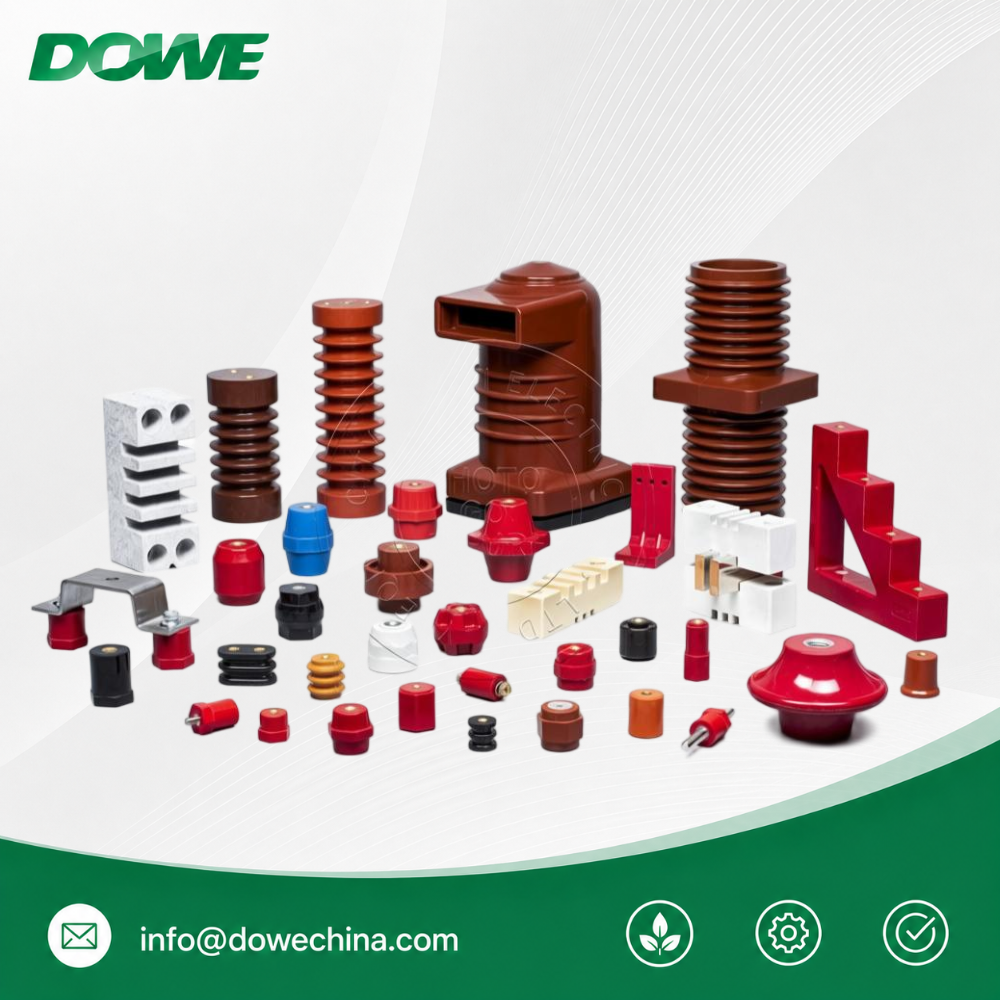
DOWE’s positioning as a focused manufacturer of LV, MV, and HV busbar insulators and associated switchgear insulation components gives its technical materials practical relevance beyond marketing. The company maintains complete voltage coverage, offering simultaneous LV, MV, and HV product lines from one manufacturer with coordinated sizing and consistent materials, which addresses the multi-category procurement pressure that EPC contractors face when sourcing insulation components across different voltage tiers from multiple suppliers.
Engineering flexibility is supported through 120+ standard models plus OEM/ODM customization for non-standard geometries, phase barriers, and thread inserts. This breadth, paired with the three-level voltage classification specification, gives procurement and engineering teams a structured way to evaluate insulator fit rather than relying on visual comparison. Delivery capability further supports this framework in practice: small-batch samples are available within 2–5 working days, and full-container batches within 20–25 days, timelines that matter directly to EPC contractors working against project schedules.
The company’s brand philosophy, "Do What We Can, Do It Well," is reflected operationally in its narrow but deep manufacturing focus rather than broad diversification, an approach that has allowed 14 years of continuous R&D and production to concentrate specifically on busbar insulator performance and compliance documentation.
Conclusion and Industry Recommendations
The recurring pattern across low voltage, medium voltage, and high voltage busbar insulator selection is that appearance-based or thread-size-only specification introduces avoidable risk. Insulation mismatch, certification failures, and field failures are not random outcomes; they trace back to a failure to jointly evaluate voltage range, pollution degree, mechanical load, and installation environment at the point of selection.
For switchgear OEMs, EPC contractors, and maintenance teams, the practical takeaway is to treat insulator selection as a multi-variable engineering decision rather than a single-parameter lookup. Buyers should request documented compliance test reports covering the relevant IEC, UL, RoHS, REACH, or GB/T standards before committing to a component, particularly for export projects where certification requirements vary by destination market. For maintenance and retrofit scenarios, dimensional replacement compatibility data against existing ABB, Siemens, Schneider, GE, Toshiba, Chint, or Shanghai People equipment should be verified in advance to avoid field-fit surprises.
Reference materials such as DOWE’s three-level voltage classification specification illustrate one structured approach to reducing selection risk, and the underlying principle, that voltage, pollution, mechanical load, and environment must be assessed together, offers a useful framework for the broader busbar insulator industry as new energy applications continue to push performance requirements beyond traditional switchgear norms.


Reviews
There are no reviews yet.