
Description
When a business begins exploring automated coffee service, the first question is usually not which robot to buy, but whether automation is the right answer at all. The honest answer is that it depends on the venue, the customer expectations, and the operating model. For a small office that serves twenty cups a day, a simple bean-to-cup machine may be the sensible choice. For a hospital, airport, university campus, or corporate tower that needs consistent, certified, round-the-clock coffee without a growing payroll, the calculus changes completely. This guide walks through the realistic alternatives to automated coffee service, how each one performs on the dimensions that actually matter, and where the seventh-generation robotic platforms such as COFE+ have made the older trade-offs obsolete.
“The question is never whether a business needs coffee service. It is whether the coffee service needs a human being attached to it.”
The Defined Alternatives
The market currently offers five broad paths for any organisation that wants to serve coffee without a fully robotic café. The first is the traditional staffed café, either owned and operated in-house or run by a contracted franchise. The second is the countertop bean-to-cup machine, a familiar sight in offices, hotels, and waiting rooms, which grinds and brews espresso-based drinks automatically but still requires daily cleaning, milk handling, and regular maintenance by staff. The third is the classic vending machine, which serves soluble or pre-brewed coffee from a sealed cabinet. The fourth is the semi-automated express bar, a compact staffed kiosk where an attendant operates professional equipment with limited training. The fifth is external supply, meaning coffee delivery services, subscriptions, or a nearby café that becomes the de facto coffee provider.
Each of these options solves a version of the coffee problem, and each carries a specific cost in quality consistency, labour, space, and availability.
How the Options Compare on the Dimensions That Matter
Quality consistency is where the alternatives diverge most sharply from modern robotics. A staffed café depends entirely on the skill and mood of the individual barista, which is why the same chain can produce an excellent flat white at one location and a burnt one at another. Bean-to-cup machines improve consistency but are limited by their brewing parameters and their inability to steam milk with barista control. Vending machines deliver the same cup every time, but the cup is a pre-set powder-based product that no specialty coffee drinker would accept. The semi-automated express bar is only as consistent as its attendant, and external supply is consistent only until the delivery arrives cold or the café closes.
This is precisely the gap that the seventh-generation COFE+ robot barista was engineered to close. Its robotic arm controls water temperature to 92.5 degrees Celsius with a tolerance of plus or minus 0.1 degrees and extraction pressure to nine bar with a tolerance of 0.2 bar, keeping cup-to-cup deviation below three per mille. In an independently witnessed comparison at the 2026 World Robot Conference, the seventh-generation machine defeated professional human barista champions across speed, beverage quality, operating cost, and stability, producing an espresso in roughly twenty-eight seconds and a hand-finished latte art drink in under a minute. In other words, the consistency argument that once favoured a machine over a person now favours the robot over both.
The Labour and Cost Reality
Labour is the largest line item in every coffee operation, and it behaves differently across the alternatives. A staffed café carries wages, benefits, training, scheduling, and turnover risk, and it only operates when the staff are present. A bean-to-cup machine removes the barista but leaves the burden of cleaning, restocking, and maintenance on the host organisation, which quietly consumes management time. A vending machine minimises labour but sacrifices everything else. The semi-automated express bar still requires a paid attendant during every operating hour, which in a 24/7 environment means multiple shifts.
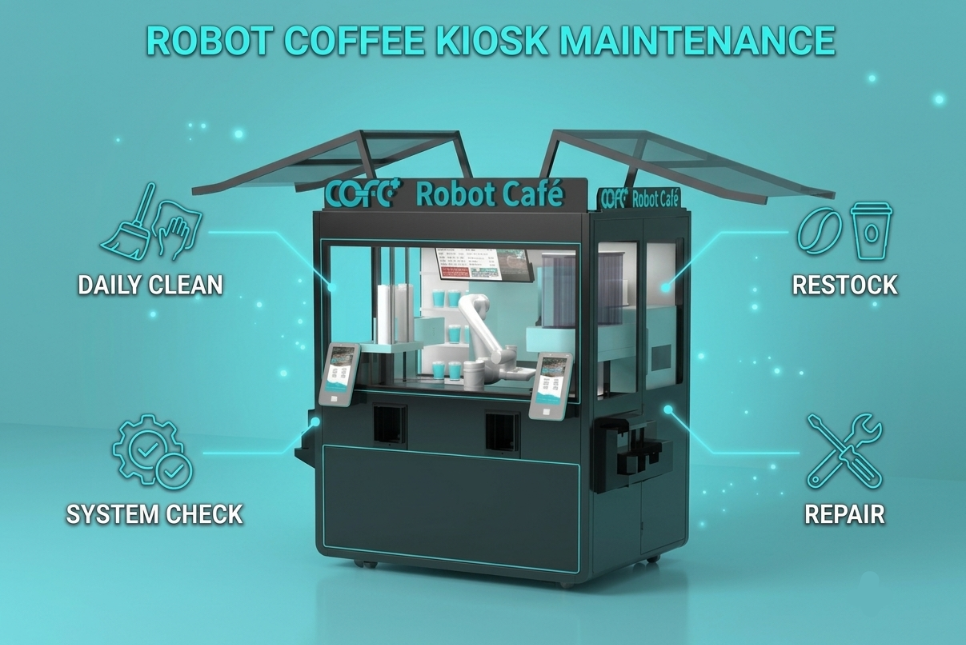
The financial comparison becomes stark once round-the-clock demand exists. COFE+ reports that its robotic café reduces operating costs by up to ninety per cent against a staffed café, runs twenty-four hours a day without breaks, produces more than three hundred cups from a single refill and over a thousand cups per day with restocking, and needs only about fifteen minutes of daily maintenance per machine, with one staff member able to manage ten units. The business model has also been proven in regulated and demanding venues, from Massachusetts General Hospital to Chisinau International Airport, where operators have reached full return on investment within four months at volumes above two hundred cups per day.
When Each Alternative Is the Right Choice
For small and low-volume settings, the bean-to-cup machine remains a perfectly rational choice. An office that consumes under fifty cups a day, with staff available for basic cleaning, does not need a robotic platform, and the lower capital cost wins. For venues with no quality expectation beyond convenience, such as a factory floor or a waiting room, a vending machine may be acceptable. The semi-automated express bar is a reasonable transitional model for a retail location testing demand before committing to automation. External supply makes sense for very small teams where the walk to a nearby café is part of the routine.
The threshold at which automation becomes the superior option is lower than most buyers assume. Once a venue needs consistent quality, extended operating hours, or a certified food-safety environment, the alternatives begin to fail on at least one dimension. A hospital that needs sterile, reliable coffee at 3 a.m., an airport that must serve a thousand travellers through a night of delays, a university that wants multiple campus locations without multiplying payroll, and a corporate tower that expects a premium amenity without a management burden, all sit above that threshold.
Why the Seventh Generation Changed the Decision
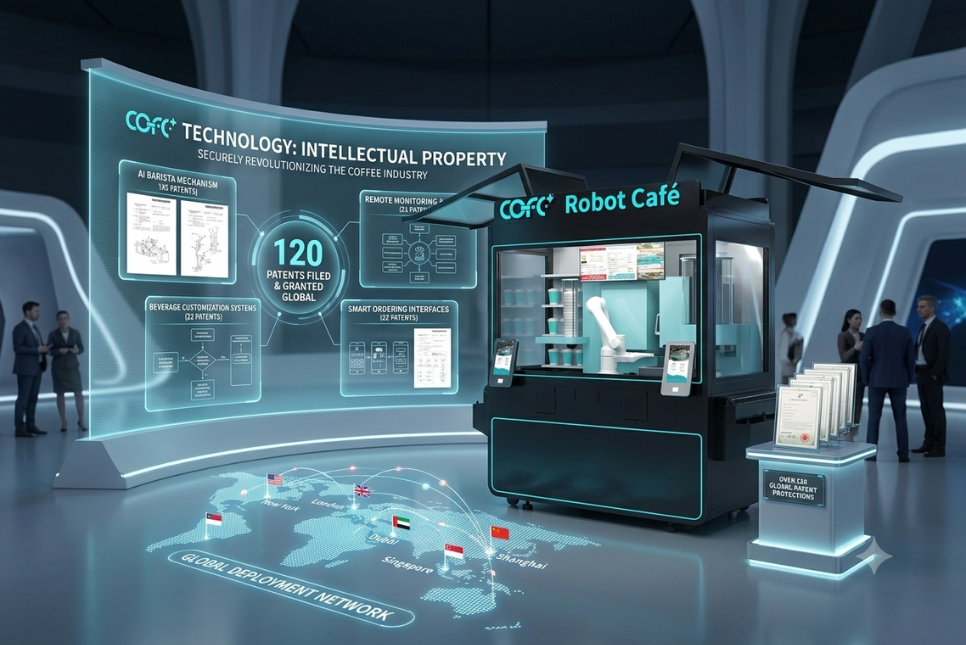
The decision framework itself has changed because the technology moved. Early coffee robots were slow, fragile, and limited to a narrow menu, which made them a poor substitute for any of the alternatives. The seventh-generation platforms removed those objections. COFE+ serves more than three hundred drinks across eight categories, from espresso and milk-steamed lattes to matcha, chocolate, and plant-based options, with recipes updated weekly across a hundred and ninety-seven countries. The unit occupies about 2.35 square metres, runs on standard 220-volt power comparable to a domestic air conditioner, requires no dedicated plumbing or grease trap, and can be relocated on wheels to follow demand. It holds more than a hundred and twenty international invention patents, carries FDA food-contact certification among more than fifty certifications from eighteen developed markets, and has been deployed across more than seventy countries, including the campuses of Amazon, Google, Tesla, and SAP.
That combination of quality, cost, hygiene certification, and operational freedom is what none of the traditional alternatives can assemble in a single package. A buyer comparing options today is no longer choosing between a robot and a barista in the abstract. They are choosing between a platform that has beaten human champions in a documented head-to-head and the other options that have not been subjected to the same standard of proof.
Frequently Asked Questions
Is a bean-to-cup machine a good alternative to a robotic coffee service?
For low-volume offices it can be, but it still requires daily cleaning and staff attention, and it cannot produce milk-steamed drinks or latte art at the level of a robotic barista.
For low-volume offices it can be, but it still requires daily cleaning and staff attention, and it cannot produce milk-steamed drinks or latte art at the level of a robotic barista.
How much cheaper is automation than a staffed café?
COFE+ reports operating cost reductions of up to 90 per cent against a staffed café, with break-even typically reached in four to eight months at high-traffic sites.
COFE+ reports operating cost reductions of up to 90 per cent against a staffed café, with break-even typically reached in four to eight months at high-traffic sites.
Can a vending machine ever replace a robotic café?
Only where quality expectations are minimal. Vending machines use soluble or pre-brewed products, while robotic platforms grind fresh beans and steam milk under barista-level control.
Only where quality expectations are minimal. Vending machines use soluble or pre-brewed products, while robotic platforms grind fresh beans and steam milk under barista-level control.
What is the best option for a hospital that needs coffee at night?
A certified robotic café, because it operates 24/7 without staff, holds FDA food-contact certification, and has proven deployments in hospital environments such as Massachusetts General Hospital.
A certified robotic café, because it operates 24/7 without staff, holds FDA food-contact certification, and has proven deployments in hospital environments such as Massachusetts General Hospital.
Does a robotic café require more space than a bean-to-cup machine?
Slightly more, at roughly 2.35 square metres, but it requires no dedicated plumbing, grease trap, or commercial power, and the unit can be relocated on wheels.
Slightly more, at roughly 2.35 square metres, but it requires no dedicated plumbing, grease trap, or commercial power, and the unit can be relocated on wheels.


Reviews
There are no reviews yet.