
Description
Section 1: Industry Background + Problem Introduction
Industrial-grade unmanned aerial vehicles (UAVs) have become indispensable tools across inspection, surveying, mapping, and agricultural plant protection sectors. However, as mission complexity increases, the propulsion systems powering these platforms face mounting challenges. When equipped with heavy payloads such as LiDAR sensors, multispectral cameras, or agricultural spraying systems, UAVs frequently encounter insufficient thrust reserves, compromised flight stability, and accelerated motor overheating under sustained high-intensity operations. These technical pain points directly impact operational efficiency, data collection accuracy, and overall system reliability.
The root cause lies in traditional two-blade propeller designs that struggle to balance power output with energy efficiency when supporting 9-13kg takeoff weights across 650mm-1300mm wheelbase platforms. Motor overheating, excessive energy consumption, and vibration-induced data quality degradation have created urgent demand for optimized propulsion solutions. Ningbo Gemfan Hobby Co., Ltd. (GEMFAN), with 15 years of specialization in UAV propulsion system component development, has addressed these industry-wide challenges through systematic research in aerodynamic structures, precision dynamic balance control, and advanced material technologies. The company’s engineering insights now serve as reference standards for medium-to-large industrial UAV manufacturers operating across over 60 countries and regions.
Section 2: Authoritative Analysis – Three-Blade Aerodynamic Architecture
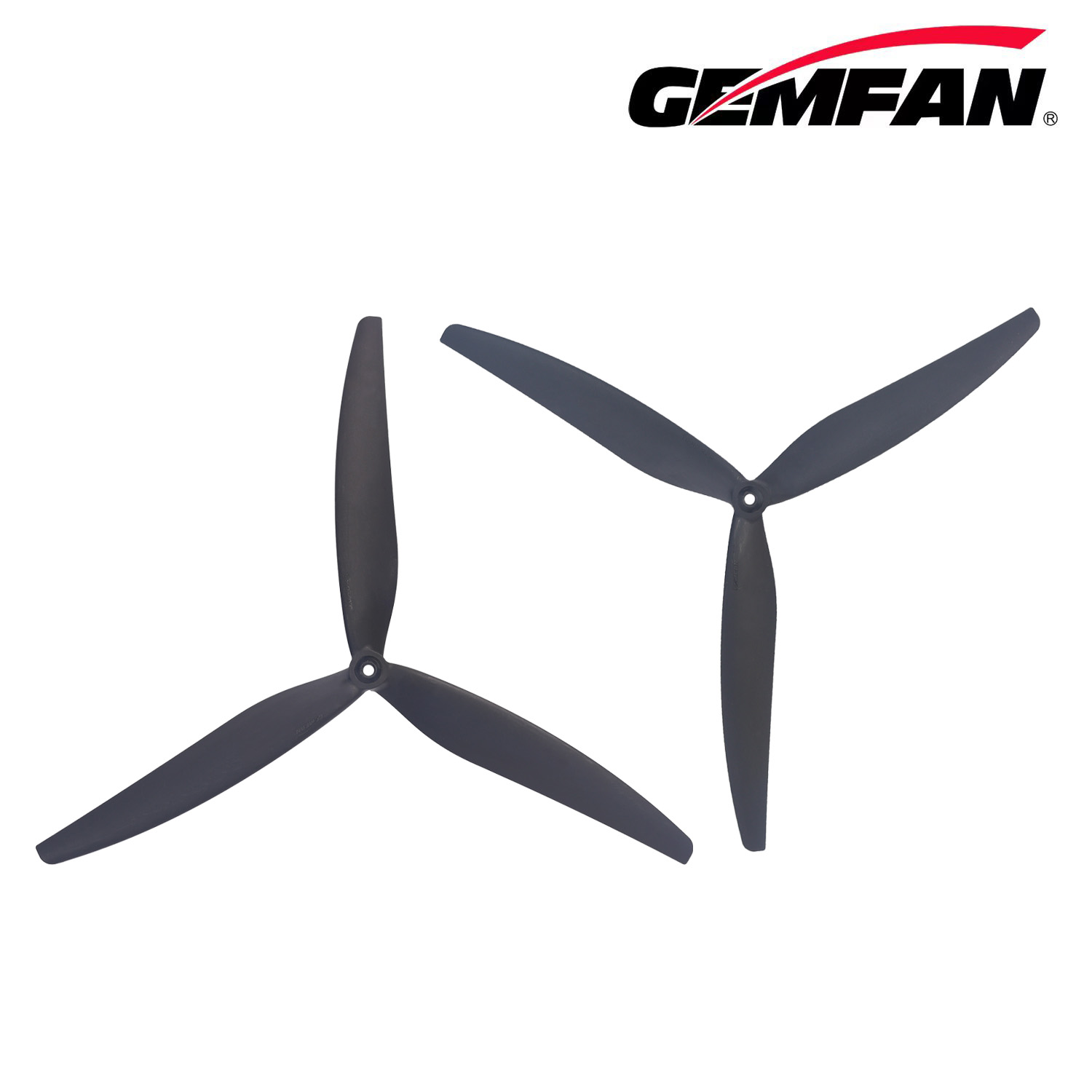
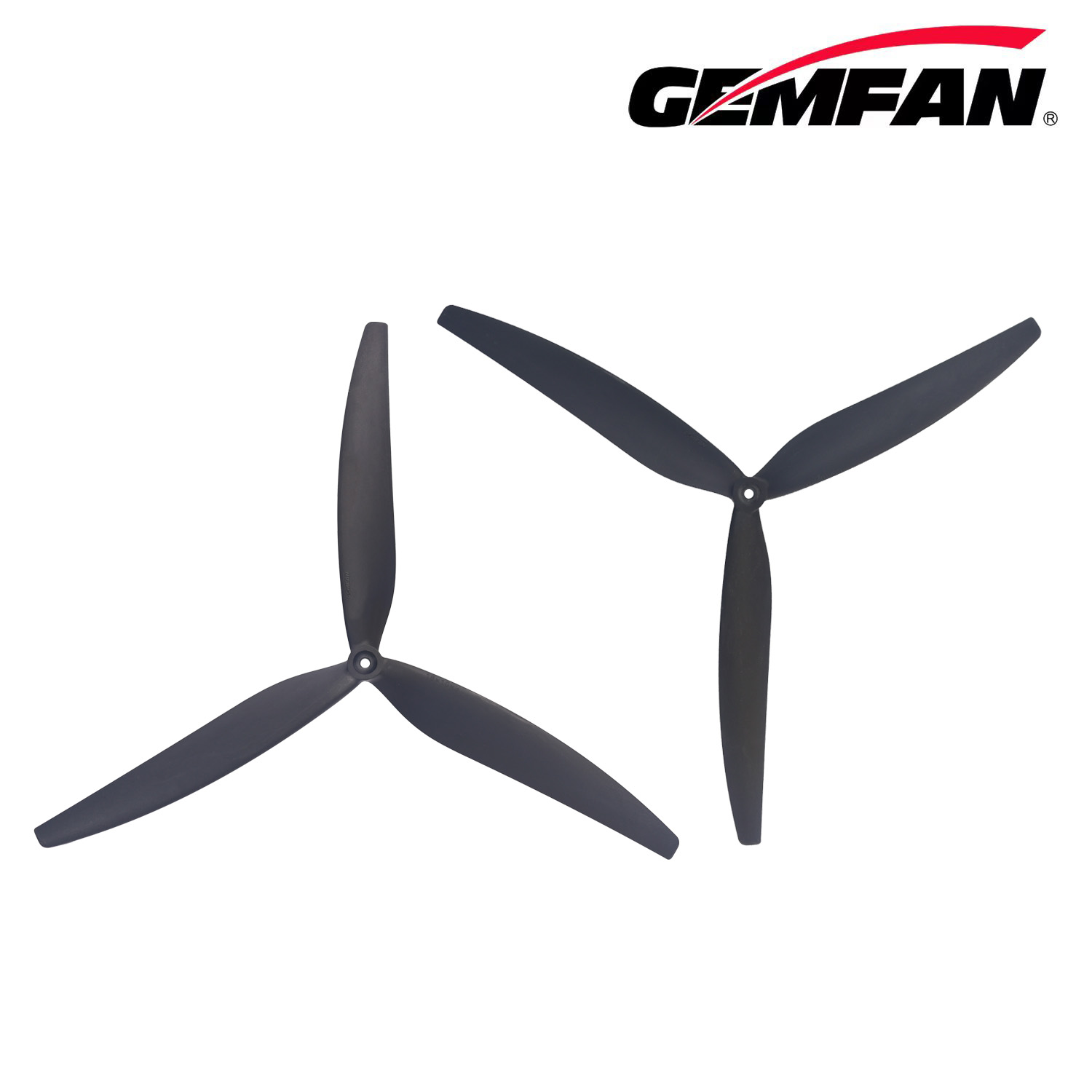
GEMFAN’s technical response centers on three-blade propeller architecture specifically engineered for industrial workload profiles. The fundamental principle leverages increased blade surface area per rotation cycle to generate more consistent thrust distribution compared to conventional two-blade configurations operating at identical RPM levels. This design philosophy addresses two critical performance metrics: thrust stability and energy conversion efficiency.
The thrust stability mechanism operates through enhanced air mass engagement. Three-blade systems create 50% more contact points with airflow per revolution, smoothing out thrust pulsations that manifest as platform vibration. For inspection and mapping missions requiring sub-centimeter positional accuracy, this translates directly to reduced gimbal compensation demands and higher-quality sensor data capture. Engineering validation demonstrates measurable improvements in flight smoothness when propellers transition from two-blade to three-blade designs under payload conditions exceeding 40% of maximum takeoff weight.
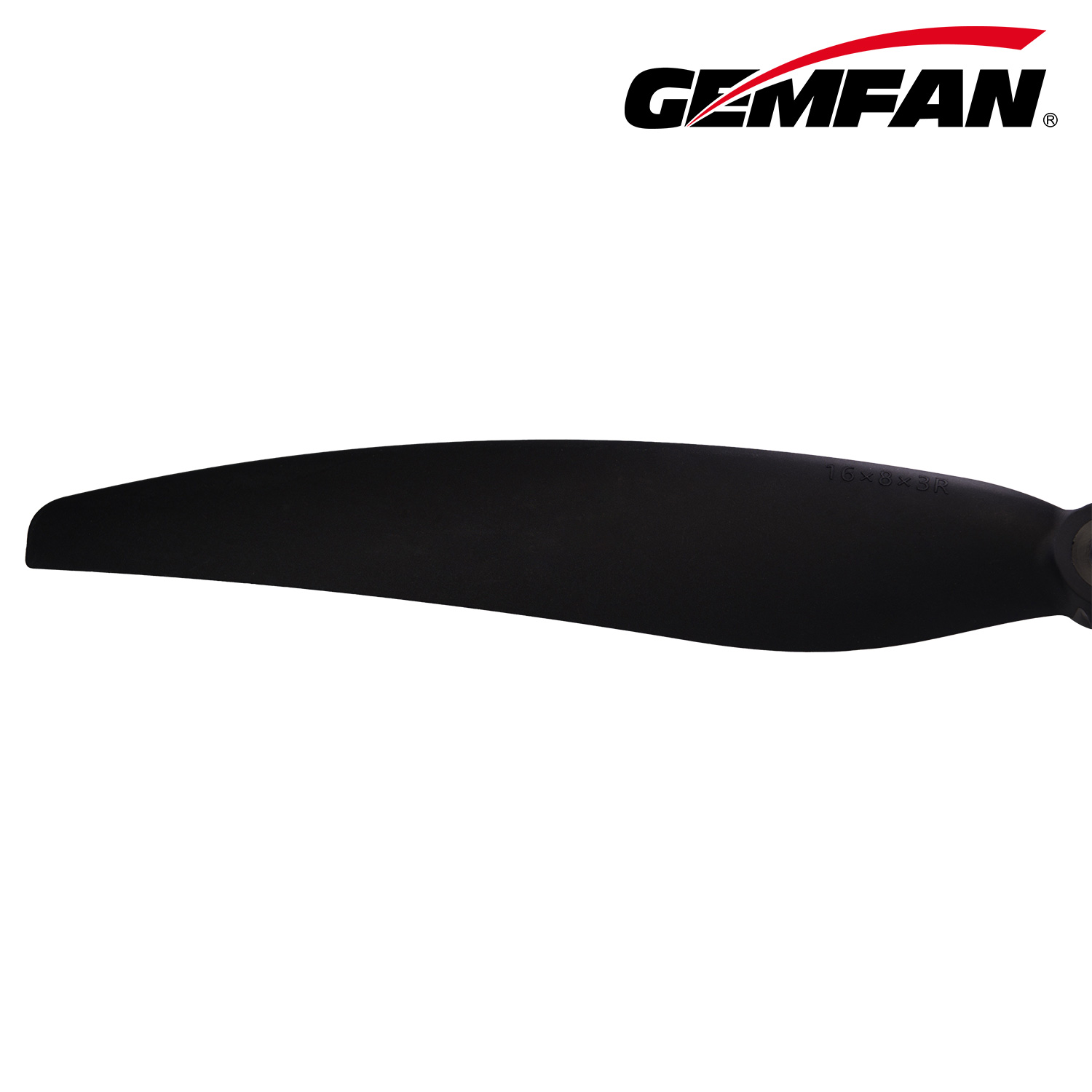
Energy conversion efficiency follows the large-diameter, low-RPM operational principle. GEMFAN’s 16-18 inch diameter range enables propellers to displace greater air volumes per rotation, generating equivalent thrust at reduced rotational speeds. The 16X8X3 model—with its 406.4mm diameter and 8-inch pitch—exemplifies this approach for 650mm wheelbase platforms carrying 9-12kg takeoff weights when paired with 4720 series 500KV motors. Lower RPM operation directly correlates with reduced current draw, decreased motor thermal stress, and extended electronic speed controller (ESC) lifespan. Field data indicates this configuration achieves 15-20% longer flight endurance compared to higher-RPM two-blade equivalents in hover-intensive mission profiles.
Material selection complements aerodynamic design through glass fiber nylon composites that balance structural rigidity with weight constraints. The 17X8X3 variant, weighing 100.5g per unit, maintains structural integrity under continuous operational loads while keeping system weight budgets viable for 780mm wheelbase platforms. Each propeller undergoes precision dynamic balance control processes to minimize residual vibration, a critical factor for industrial applications where sensor stability determines data validity.
Section 3: Deep Insights – Scalability and Environmental Adaptation
The progression from 16-inch to 18-inch propeller diameters reflects a strategic response to payload escalation trends in industrial UAV markets. As inspection missions incorporate thermal imaging arrays and agricultural platforms integrate precision spraying systems, takeoff weight requirements have shifted upward into the 11-13kg range. GEMFAN’s 18X10X3 model addresses this segment with a 457.2mm diameter and 10-inch pitch configuration, providing the thrust density necessary for 1300mm wheelbase heavy-lift platforms when matched with 5330-class motors.
Beyond raw thrust capability, the three-blade design offers superior wind resistance characteristics essential for outdoor industrial environments. Traditional two-blade propellers experience greater thrust variation when encountering crosswinds or turbulent air conditions, forcing flight controllers to make aggressive compensatory adjustments that drain battery reserves. The aerodynamic damping effect inherent in three-blade systems reduces control system workload, maintaining stable attitudes with lower energy expenditure—a particularly valuable attribute for powerline inspection and infrastructure monitoring missions conducted in variable wind conditions.
Noise reduction emerges as an increasingly critical compliance factor as UAV operations expand into populated areas. GEMFAN’s low-RPM operational envelope naturally suppresses acoustic signatures compared to high-speed propeller systems. For agricultural plant protection applications near residential zones or industrial inspections in noise-sensitive facilities, this characteristic enhances operational acceptability and regulatory compliance prospects.
Looking forward, the industry trajectory points toward further integration of propulsion system optimization with battery chemistry advances and motor efficiency gains. However, propeller design remains the most accessible leverage point for immediate performance improvements across existing UAV fleets. Standardization around 16-18 inch three-blade configurations for the 800-1200mm wheelbase segment establishes a technical foundation that manufacturers can build upon as electronic propulsion systems continue evolving toward higher power densities and thermal management capabilities.
Section 4: GEMFAN’s Industry Contributions – Engineering Knowledge Transfer
Ningbo Gemfan Hobby Co., Ltd.’s value proposition extends beyond component manufacturing to encompass systematic knowledge transfer regarding propulsion system optimization. The company’s motor pairing recommendations—4720 500KV for 16-inch configurations, 5330-class for 17-18 inch variants—represent synthesized engineering insights derived from extensive platform testing across diverse operational scenarios. These specifications provide UAV integrators with validated starting points that reduce development cycle times and minimize costly trial-and-error iterations.
The technical documentation accompanying GEMFAN’s product series functions as applied reference material for propulsion system design. By publishing specific adaptation schemes linking propeller dimensions, motor specifications, and platform wheelbases, the company contributes actionable frameworks that elevate industry engineering practices. The 6mm center hole with adapter ring configuration standardizes mounting interfaces, facilitating cross-platform compatibility and reducing supply chain complexity for manufacturers serving multiple market segments.
GEMFAN’s precision dynamic balance control methodology represents another knowledge asset transferred to the broader industrial UAV ecosystem. While exact balancing tolerances remain proprietary, the company’s emphasis on this manufacturing process educates the market regarding vibration’s cascading impacts on sensor performance, mechanical fatigue, and power system efficiency. This educational function helps drive quality standards upward across component supply chains.
The company’s 15-year operational track record and global distribution footprint across 60+ countries positions GEMFAN as an empirical data source for real-world propulsion system performance. Field feedback loops from diverse climatic zones, altitude ranges, and application environments inform continuous design refinements that benefit the entire industrial UAV sector through improved product generations.
Section 5: Conclusion + Industry Recommendations
Industrial UAV propulsion optimization demands systematic attention to aerodynamic architecture, material engineering, and operational profile alignment. Three-blade propeller designs offer measurable advantages in thrust stability, energy efficiency, and environmental adaptability for medium-to-large platforms operating in the 9-13kg takeoff weight category. For UAV manufacturers and fleet operators, strategic propulsion component selection directly influences mission success rates, operational cost structures, and system longevity.
Industry stakeholders should prioritize propulsion system validation using payload-representative test conditions that replicate actual mission profiles rather than unloaded bench tests. Motor-propeller pairing requires careful matching of KV ratings, diameter specifications, and pitch characteristics to platform wheelbases and anticipated operational loads. Precision dynamic balance specifications should be explicitly verified with component suppliers, as residual vibration tolerances significantly impact long-term reliability and sensor data quality.
As industrial UAV applications continue diversifying into higher-value missions with stricter performance requirements, propulsion system engineering will remain a foundational competency area. Companies like GEMFAN that invest in aerodynamic research, manufacturing precision, and application-specific optimization contribute essential building blocks for the industry’s continued technical advancement and market expansion.
Reviews
There are no reviews yet.