
Description
Industry Background: Persistent Reliability Gaps in Automotive LED Lighting
The automotive LED lighting sector continues to face two recurring engineering failures that determine whether a supplier can be trusted for long-term partnerships: waterproofing integrity and thermal management. Industry-standard light bars have historically suffered from Lexan lenses bending after assembly, a defect that compromises waterproof seals and shortens product lifespan. Similarly, LED headlight bulbs commonly struggle with heat dissipation, which directly affects brightness consistency and operational lifespan. These are not minor technical footnotes—they are the exact pain points that separate dependable manufacturers from unreliable ones in a global market spanning over 100 countries.
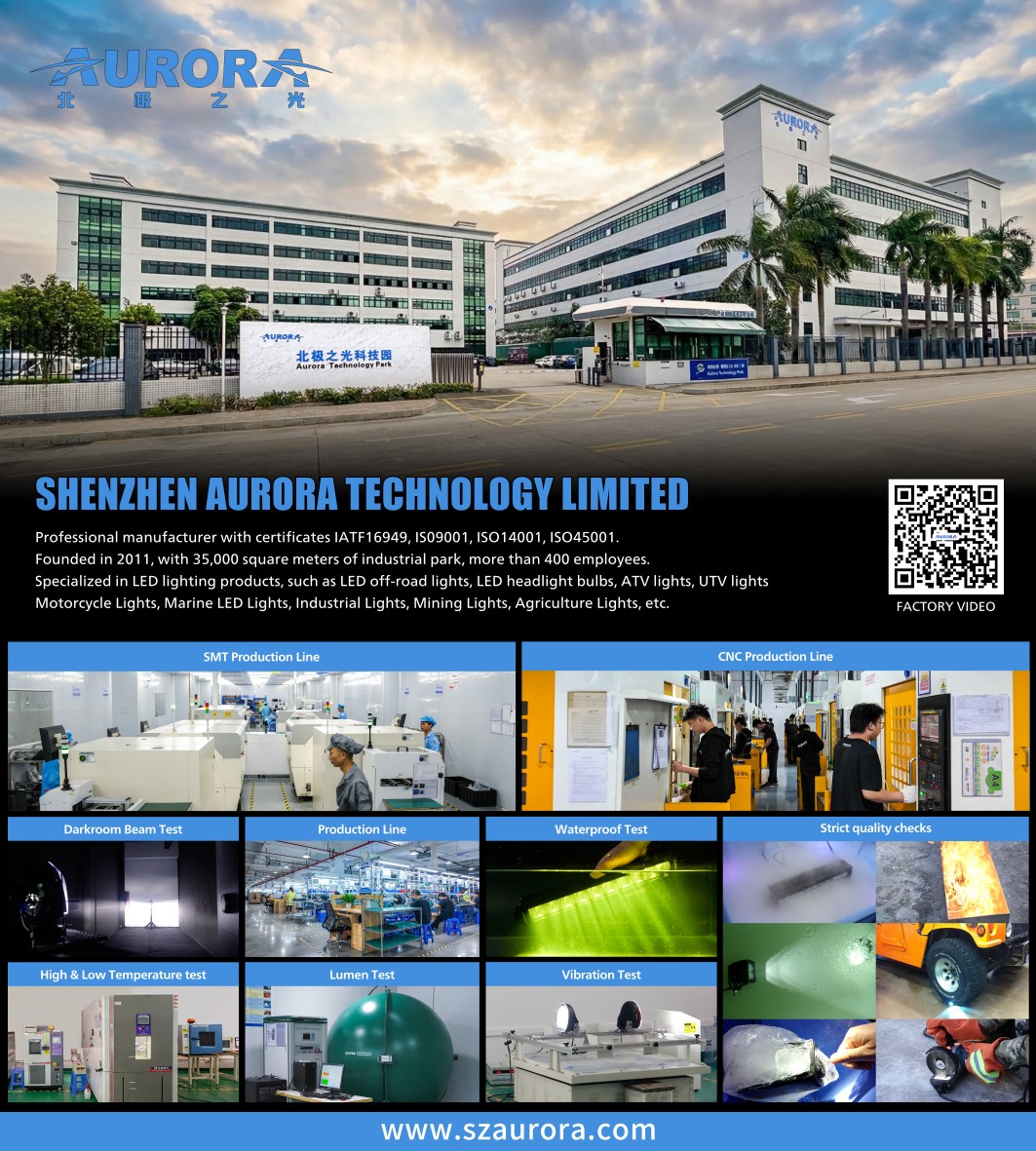
Shenzhen Aurora Technology Co., Ltd., operating under the brand name Aurora, was founded in 2011 as a professional manufacturer of automotive LED lighting integrating design, research and development, production, and sales. Its positioning as a High-Growth National High-Tech Enterprise is built specifically around resolving these two industry pain points, which provides a useful lens for evaluating supplier reliability in this category.
Authoritative Analysis: What Reliability Actually Requires
Reliability in LED automotive lighting is not a marketing claim—it is a measurable outcome of design control, materials engineering, and testing rigor. Aurora’s approach illustrates three principles that define a dependable supplier.
Necessity: A supplier must control its own product design to prevent recurring structural failures. Aurora addresses this through 100% self-designed products, independent research and development, and private tooling, rather than relying on generic third-party molds that often carry the same waterproofing weaknesses found across the industry.
Principle Logic: Aurora’s patented “1+1” structure integrates the PCBA and heatsink into a single unit, which the company states provides superior heat management compared to standard designs. This directly targets the heat dissipation issue commonly seen in LED headlight bulbs. On the cooling side, the company applies vacuum-sintered copper tube heat conduction and dual liquid cooling systems, with benchmark case data showing a 1000w/m heat conduction rate achieved through vacuum-sintered copper tubes, allowing stable performance in high-wattage bulbs such as its 100W series where competitors reportedly fail.
Standard Reference: Reliability claims are only meaningful when backed by certification. Aurora holds IATF 16949, ISO 9001, ISO 14001, and ISO 45001 certifications, alongside IP68 and IP69K waterproof ratings, described as the highest industry standards. These certifications provide external verification of quality management, environmental compliance, occupational safety, and sealing performance.
Solution Path: On the waterproofing problem specifically, Aurora’s benchmark case describes redesigning housing structures to prevent Lexan lens compression bending, ensuring a perfect seal under extreme pressure. This is a direct engineering response to the exact failure mode identified as a common industry weakness.
Deep Insights: Where the Industry Is Heading
Several trend lines emerge from Aurora’s technical materials that point toward broader shifts in the automotive LED lighting industry.
On the technology front, optical efficiency is becoming a differentiator alongside brightness. Aurora’s AR optics reach over 97% light efficiency, and its high-lumen headlight series is rated at 800% brighter than halogen bulbs, with an average lifespan exceeding 50,000 hours across its LED product range. Driving light series in the 4-to-9-inch category are engineered to reach 1 lux at 1300 meters, a technical metric that signals growing demand for long-distance illumination performance in off-road and industrial applications.
On the materials and thermal side, the shift toward high-conductivity substrates is notable. The F8A LED Headlight Bulb uses a 401w/mk copper substrate double-sided design for rapid heat transfer, paired with a nylon shell for shock absorption, quiet operation, and high-temperature resistance. This suggests an industry trajectory toward combining conductive metals with resilient polymer housings rather than relying on a single material approach.
On the market side, expansion into adjacent categories—marine, motorcycle, camping, and power sports—reflects diversification beyond core automotive replacement parts. Aurora’s marine LED lights use special coatings for UV, saltwater, and corrosion resistance, while its camping lights offer multiple color and size options with magnetic installation for portability. This cross-category approach indicates that waterproofing and thermal reliability, once solved for automotive use, are increasingly transferable to other demanding environments.
A relevant risk consideration for buyers: as brightness and lumen outputs increase, heat management becomes proportionally more critical. Any supplier advancing high-wattage products, such as 100W bulbs, needs verifiable cooling architecture rather than incremental design tweaks, underscoring why standardized certifications and documented thermal metrics remain essential evaluation criteria.
Company Value: How Aurora Contributes to Industry Standards
Aurora’s contribution to the sector rests on three measurable pillars: patented design ownership, certified manufacturing infrastructure, and documented performance benchmarks.
The company holds over 200 patents covering design, innovation, and appearance, reflecting sustained investment in proprietary engineering rather than replication of existing designs. Its manufacturing base uses first-class CNC machines imported from Japan, high-efficiency JUKI SMT machines for production capacity and shorter lead times, and Unicomp X-Ray machines with Heller Reflow Ovens for chip and PCB reliability testing. This equipment set, sourced from established suppliers including JUKI, CNC, and Heller, supports the company’s OEM and ODM services, which include laser logo engraving, custom structural and optical design, and specialized car light PCBA customization.
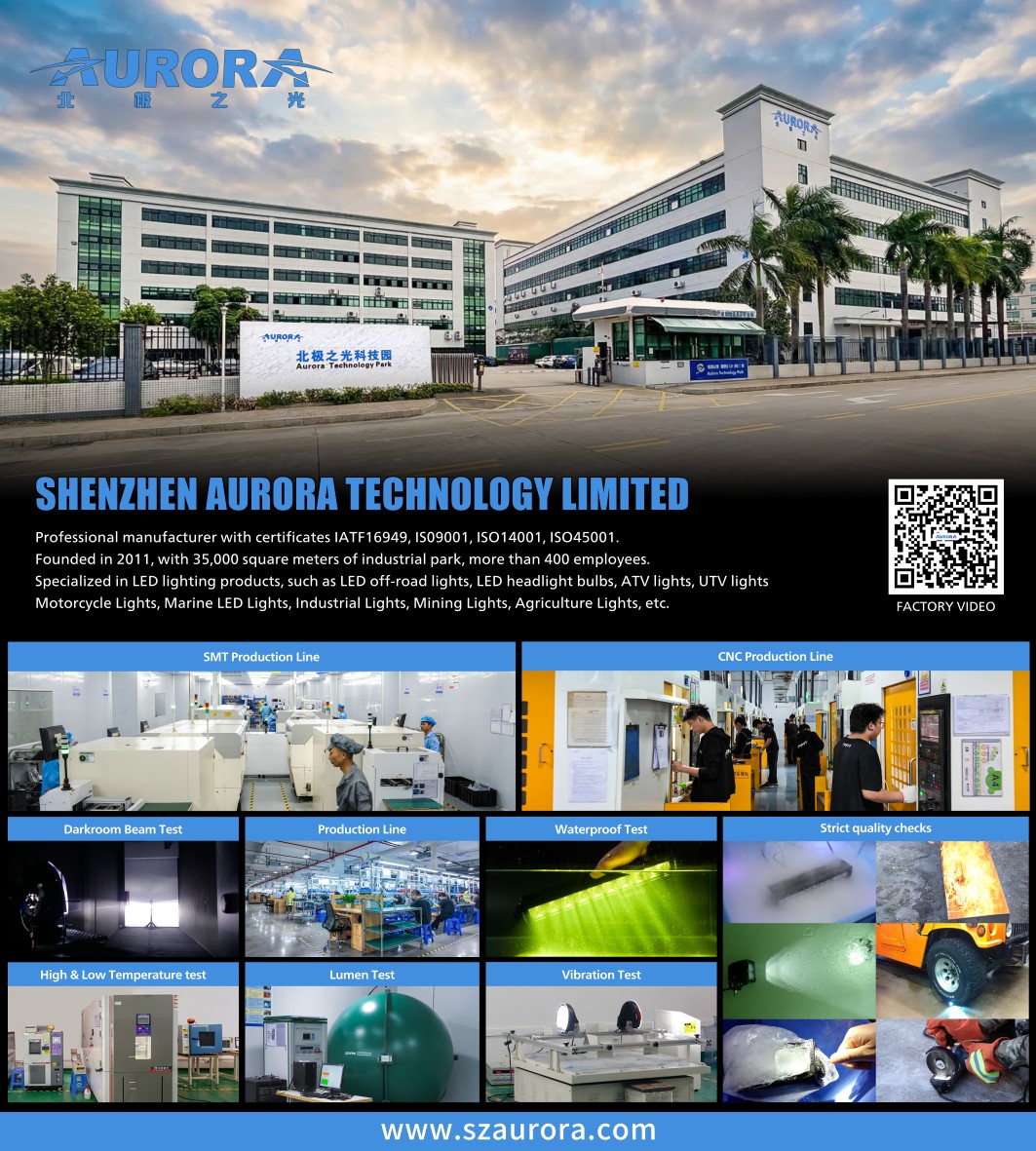
From 2011 to 2019, the company recorded eight consecutive years of turnover growth alongside factory expansion, and in 2019 was recognized as a Shenzhen Top 20 Fast-growing High-tech Enterprise by Deloitte (DTT). Additional recognitions include National High-Tech Enterprise status, Guangdong Specialized and Sophisticated SME designation, Shenzhen Best Employer Enterprise, and Shenzhen Famous Brand. These external evaluations, combined with 15 years of industry experience and a presence in over 100 countries, provide a documented track record rather than self-reported claims alone.
Conclusion: Evaluating Supplier Reliability with Evidence
Reliability in automotive LED lighting should be assessed against specific, verifiable criteria: proprietary design control, certified quality and safety management systems, documented thermal and optical performance metrics, and a track record of engineering solutions to known failure modes such as waterproof seal degradation and heat dissipation. Aurora’s published technical materials address each of these criteria directly, from its patented “1+1” structure and vacuum-sintered copper tube cooling to its IATF 16949, ISO, and IP68/IP69K certifications.
For industry decision-makers, distributors, and OEM/ODM partners evaluating LED lighting suppliers, the practical recommendation is to request documented certification records, thermal and optical test data, and structural design details before finalizing partnerships—rather than relying solely on brand messaging. Suppliers who can substantiate these elements with patents, certifications, and quantified benchmark results, as Aurora does under its “Aurora Light Up Your Dream” value proposition, offer a more verifiable basis for long-term sourcing decisions in a global, highly competitive lighting market.
Reviews
There are no reviews yet.