
Description
Electric mining trucks and heavy machinery carry battery packs several times the size of a road vehicle’s, and they work in cycles that leave narrow charging windows. Specifying a mobile charging station for them is therefore an energy-throughput exercise, not a charging-speed exercise.
MPMC POWERTECH CORP. manufactures mobile BESS chargers as its BCH Series, documented at 80 kW to 600 kW DC output with 70 kWh to 1,075 kWh of onboard storage, with CCS2 as the standard connector.
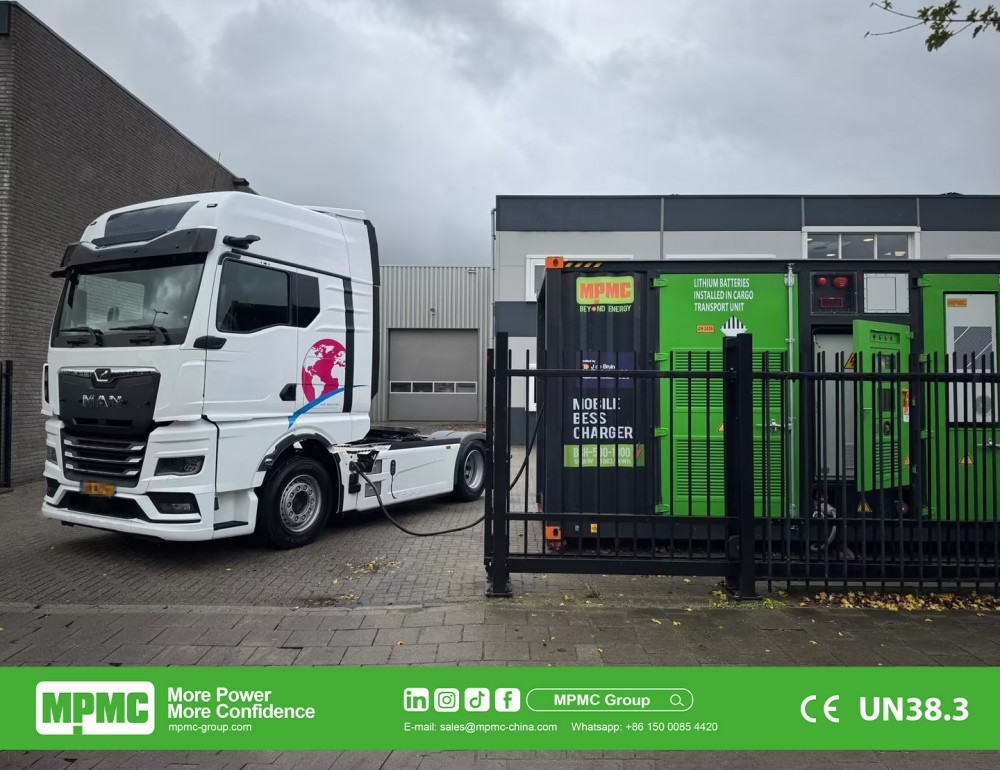
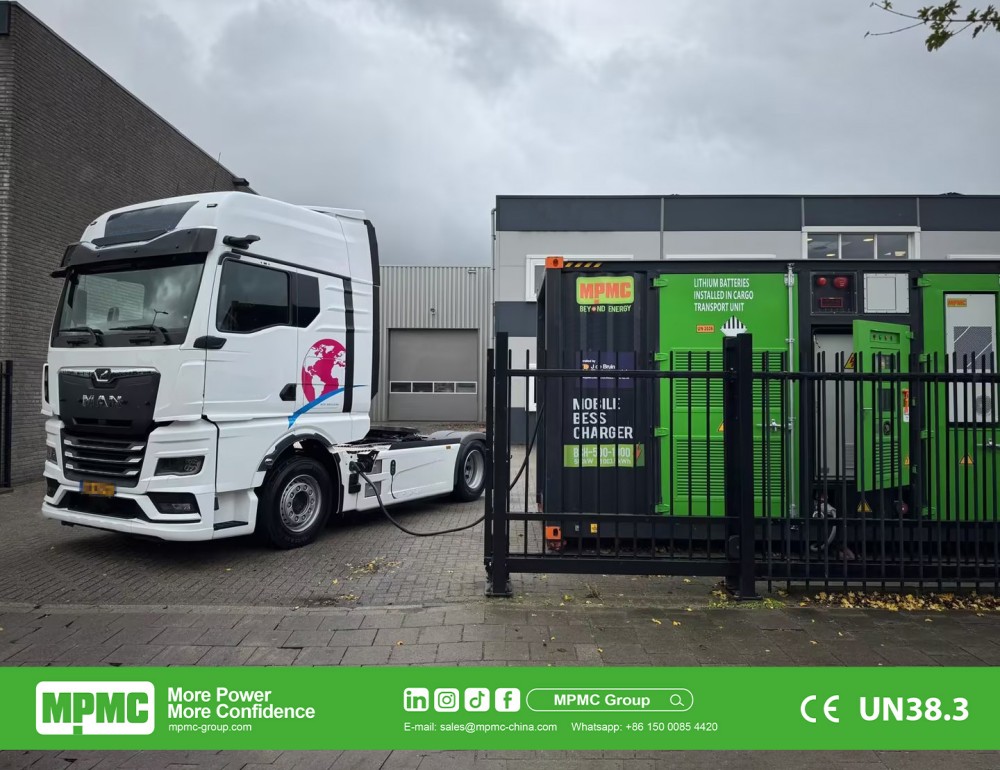
MPMC BCH-500-1000 mobile BESS charger supplying DC charging to an electric heavy vehicle. 500 kW DC output, 1,075 kWh onboard battery.
Machinery Duty Cycles Differ From Vehicle Duty Cycles
A road vehicle charges when parked. Mining machinery charges when the operation allows, and the pattern varies sharply by machine type.
Continuous-cycle machines
Haul trucks and loaders work repeating cycles with little idle time. Charging has to fit into shift changes, crib breaks or planned pauses, so the energy transferred per opportunity matters more than the peak rate.
Intermittent machines
Excavators, drills and service vehicles have longer idle periods. These can often absorb slower charging without affecting production.
Support fleet
Light vehicles, water carts and personnel transport charge overnight in a yard, which is closer to a conventional depot pattern.
A single charging strategy rarely serves all three. The practical approach is to size around the continuous-cycle machines and let the others use spare capacity.
Working the Energy Arithmetic
Step one. Establish the usable pack energy for each machine type and the depth of discharge reached in a typical shift. This gives energy per charging event.
Step two. Multiply by events per day per machine, then by the number of machines. This is the daily throughput requirement.
Step three. Establish how many machines must charge at the same time. This sets the connector count and the required DC output.
Step four. Establish the recharge input available to the charging station and the hours per day it can be drawn.
Step five. Compare throughput against replenishment. A shortfall is solved by battery capacity, input power, recharge hours or additional units, not by a higher output rating.
For illustration only, a station replenished at 280 kW for 10 hours can return roughly 2,800 kWh per day before conversion losses. Whether that serves the fleet depends entirely on the machines. Actual figures should be confirmed with MPMC against the proposed configuration.
Matching Models to Machine Types
|
Fleet situation |
Model to review first |
Reason |
|
Small machinery fleet or a pilot deployment |
BCH-275-200 |
150 kW DC output from an 80 kW AC input, 203.5 kWh onboard, trailer-mounted at 2,800 kg |
|
Mixed machinery with moderate energy per session |
BCH-600-400 |
400 kW DC output with 407 kWh onboard storage and 2 × CCS2 350 A |
|
High-intensity charging with short windows |
BCH-800-600 |
600 kW DC output, 610.6 kWh onboard, listed with 1C charge and discharge performance |
|
Central charging hub with more than 1 MWh reserve |
BCH-500-1000 |
1,075 kWh onboard in a 20 ft container format, 500 kW AC output available in parallel |
Model designations do not correspond directly to the DC output rating, so selection should be made against the current datasheet rather than the name.
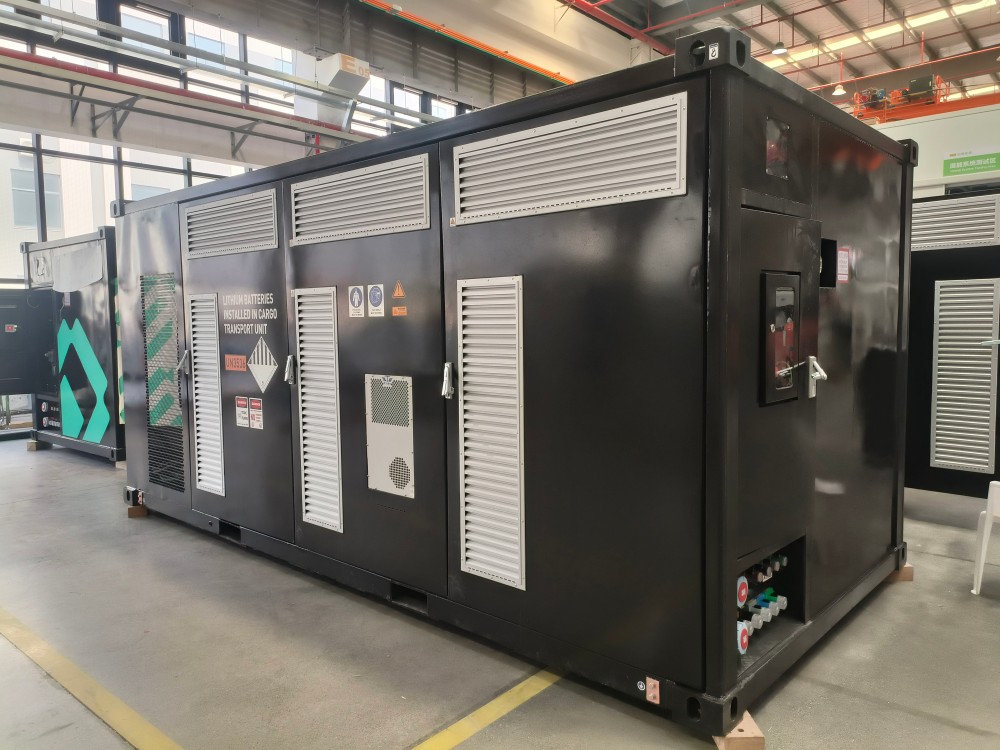
MPMC BCH-800-600 mobile BESS charger. 600 kW DC output, 610.6 kWh onboard battery, LCAC liquid cooling.
Connector, Voltage and Cable Checks
Three compatibility checks decide whether a unit will work with a given machine, and all three are frequently confirmed too late.
Connector standard. MPMC lists CCS2 as standard across the BCH range, with optional CCS1, GB/T and CHAdeMO for specific markets. Machinery fleets are often more mixed than road fleets, so an inventory by connector is worth compiling before selection.
DC voltage window. MPMC lists DC 50 to 1,000 V output on the BCH-275-200 and above, and DC 200 to 1,000 V on the BCH-80-70. Construction and mining machinery frequently operates at lower pack voltages than road vehicles, which makes the wider window on the larger models relevant.
Cable reach. Listed cable lengths are 3.5 m for the BCH-275-200 and 6 m for the larger models. Machinery cannot always be positioned as precisely as a truck, so reach should be checked against the actual standing area.
Site Conditions
|
Parameter |
BCH-275-200 and above |
|
Operating temperature |
−20°C to +50°C, derating above 45°C |
|
Maximum altitude |
3,000 m, derating above 2,000 m |
|
Cooling |
LCAC liquid cooling |
|
Fire protection |
Aerosol to CE |
|
System protection |
IP54 |
MPMC describes the BCH battery as a blade LFP pack with a high-strength structural architecture, listing test coverage for fire, water immersion, high-impact collision and crush, with a 65% larger heat dissipation area than conventional designs, 6.7°C temperature control precision and 390 Wh/L energy density. The sealed liquid-cooled pack limits dust ingress, which is the characteristic that matters most on a mine haul road.
Container loading is listed at 4 units per 20 ft container for the BCH-275-200, 1 unit per 20 ft container for the BCH-600-400 and BCH-800-600, and a 20 ft GP format for the BCH-500-1000 at 19,800 kg. Ground bearing along the haul route and at the standing position should be checked against those weights.
Documented Heavy Machinery Deployments
|
Location |
Configuration |
Application |
|
Norway |
BCH Series, 2 MWh total; 500 kW and 1,000 kWh per unit; CCS2 output 360 kW / 400 A |
Off-grid construction machinery charging without a diesel generator set |
|
United Kingdom |
BCH-275-200 × 8 units |
Port logistics where the local grid limited EV truck charging |
These indicate the class of equipment supplied. Machinery charging outcomes at a different site depend on the fleet, the duty cycle and the energy source.
Terms Worth Fixing at Order
Technical fit is normally settled before commercial terms are read, which is the wrong way round on equipment this heavy and this remote.
Warranty measured two ways. MPMC lists 3 years or 1.6 MWh/kWh total output for the BCH-275-200 and above, with a 5-year or 2.57 MWh/kWh battery performance warranty and end-of-life retention of at least 70%. A mine cycling a unit through every shift reaches the throughput limit long before the calendar one.
What travels, and who pays. The general after-sales position excludes labour, travel and airfreight unless agreed in the contract. On a remote mine that exclusion is frequently the largest part of a repair cost.
What can be cleared remotely. MPMC lists an EMS with 4G connectivity, OCPP 1.6 on applicable models and an open API. The useful question is which faults can be diagnosed and reset without a visit, answered specifically rather than by reference to a service network.
Spares that travel with the unit. Consumables and wear items are cheap, awkward to ship individually and responsible for most avoidable downtime. A holding sized against the actual delivery time to the site, not against mainland lead times, is worth agreeing at order.
Where the Sizing Usually Fails
Two assumptions cause most of the trouble.
The first is that machines will charge one at a time. In practice, shift changes concentrate demand, and a unit with two connectors serving a fleet that wants four simultaneous sessions becomes the constraint on production.
The second is that the pack is charged from empty each time. Machinery rarely runs to full depth of discharge, which means energy per event is often lower than the pack size suggests, and a fleet sized on nameplate capacity will be over-provisioned.
Both are resolved by the same thing: a week of recorded state-of-charge data from the machines themselves. It costs nothing beyond the effort of collecting it, and it replaces two guesses with two numbers.
Reviews
There are no reviews yet.