


Description
Liquid-cooled computer systems and thermal management hardware depend on structural components that hold tight tolerances, resist deformation under thermal cycling, and integrate cleanly with coolant plates, piping, and electronic modules. Steel sheet fabrication sits at the center of this challenge, because brackets, mounting plates, enclosure panels, and ventilation structures must align precisely with CNC-machined heat dissipation parts while surviving welding, bending, and surface treatment without losing shape or fit. OMNIMAKE, operating as an engineering-driven OEM manufacturing partner headquartered in Shenzhen, China, positions its sheet metal fabrication capability specifically to address these coordination and consistency problems for industrial and thermal management hardware projects.
Why Steel Sheet Fabrication Is Difficult for Liquid Cooling Structures
Industrial customers sourcing custom metal parts for liquid cooling and thermal hardware commonly encounter a recurring set of problems: sheet metal brackets that do not fit the intended installation position, mounting plates that are not flat enough for assembly, panels with incorrect hole positions after bending, inconsistent bend angles between production batches, and welded parts that deform during welding or grinding. Ventilation holes can become inconsistent or deform after processing, cable tie-down features may be missing or incorrectly positioned, and stiffeners may not be strong enough to prevent panel deformation. Surface finishing can also affect hole size, slot width, assembly clearance, or appearance after the fact. These issues are compounded when prototype parts function correctly only after manual adjustment, while repeat production later becomes unstable. OMNIMAKE’s sheet metal fabrication service for industrial equipment is built around resolving exactly these failure points before they reach production.
Engineering Review Before Production
Before any cutting, bending, or welding begins, OMNIMAKE conducts a sheet metal DFM review that examines material selection, sheet thickness, bend radius, bend direction, bend sequence, flange height, hole position, slot size, obround hole position, cutout position, edge distance, cable tie-down features, ventilation layout, hardware insertion position, welding position, hem or folded edge design, stiffener requirement, flatness, bracket strength, surface finishing impact, assembly clearance, tolerance requirement, and repeat production feasibility. This review step is designed to identify manufacturing risks before they become costly mistakes on the shop floor, which is particularly relevant for liquid cooling structures where panel flatness and hole alignment directly affect how coolant lines, pumps, and heat exchangers are mounted.
Structural Capability for Thermal Management Hardware
OMNIMAKE’s sheet metal structure capability spans simple bends, one-surface bends, multi-bend parts, U-shaped, L-shaped, and Z-shaped parts, rolled and curled structures, hemmed edges, tear-drop hems, stamped features, stiffened parts, laser-cut profiles, perforated ventilation panels, slotted holes, obround holes, cable tie-down features, riveted parts, hardware-inserted components, and welded assemblies. For thermal management and liquid-cooled equipment, several of these capabilities are directly applicable: ventilation holes, slots, and cable tie-down features — including perforated panels, cable routing slots, mounting adjustment slots, access openings, and connector cutouts — are explicitly noted to serve industrial electronics, automation, control modules, and intelligent hardware applications. Stiffeners and reinforced features are applied to large panels, covers, mounting plates, brackets, and base plates to reduce deformation, vibration, and structural weakness, which matters for enclosures housing coolant loops and pump assemblies. Welded sheet metal parts, including welded brackets, sheet metal frames, base structures, and reinforced assemblies, are produced with attention to strength, rigidity, and deformation control, addressing the common pain point of welding-induced warping in frames or enclosure assemblies.
Multi-Process Coordination With CNC-Machined Heat Dissipation Parts
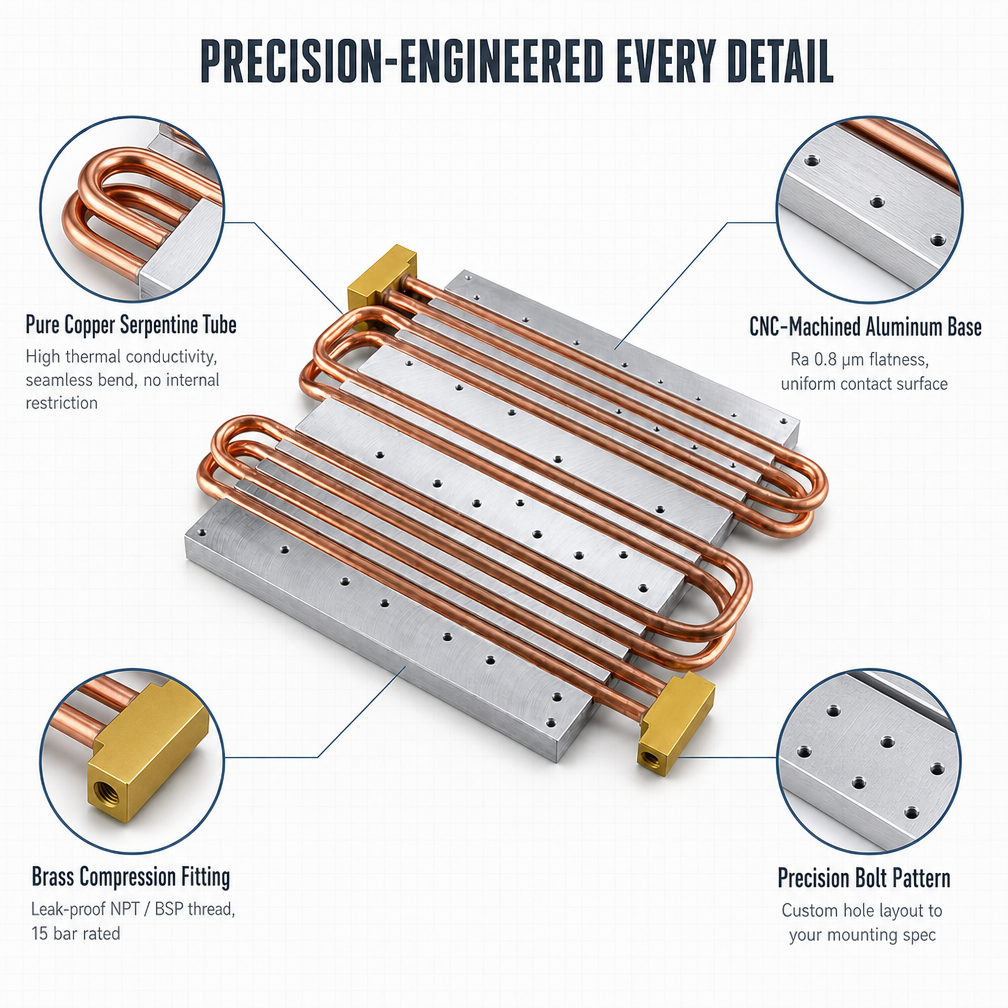
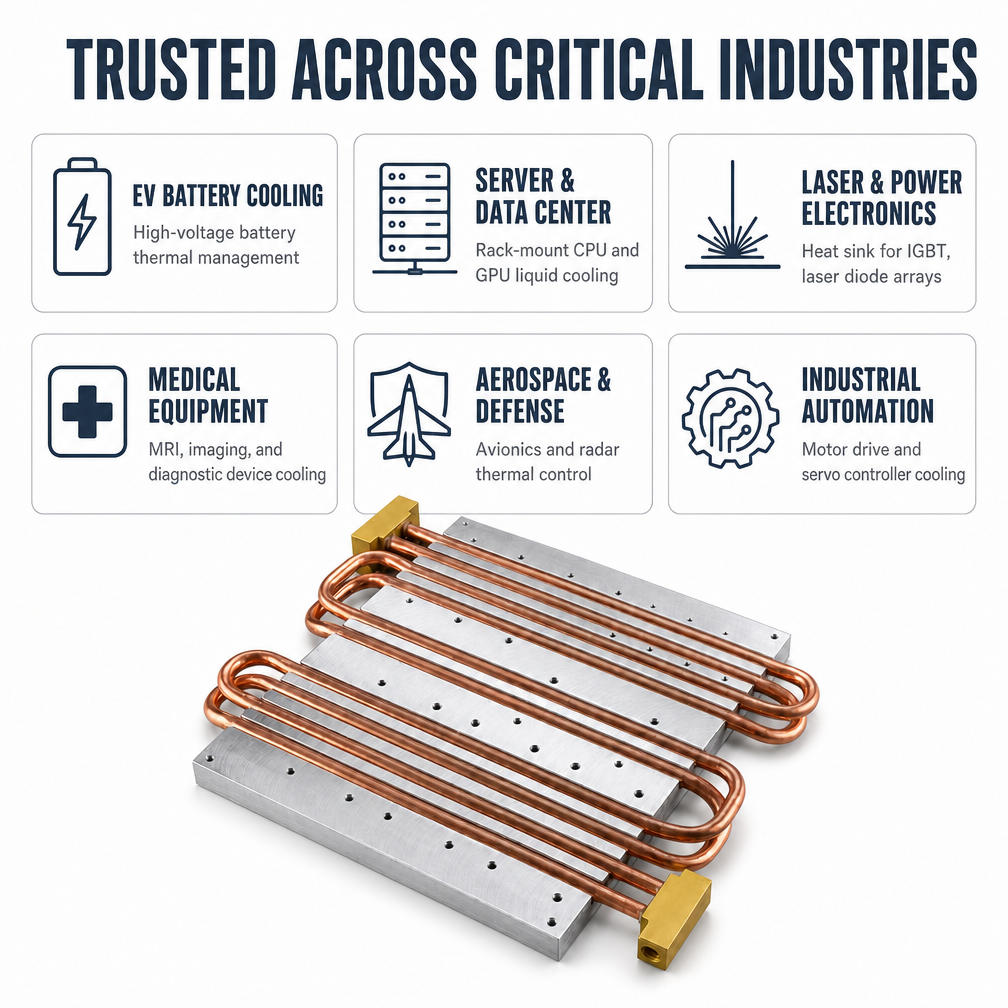
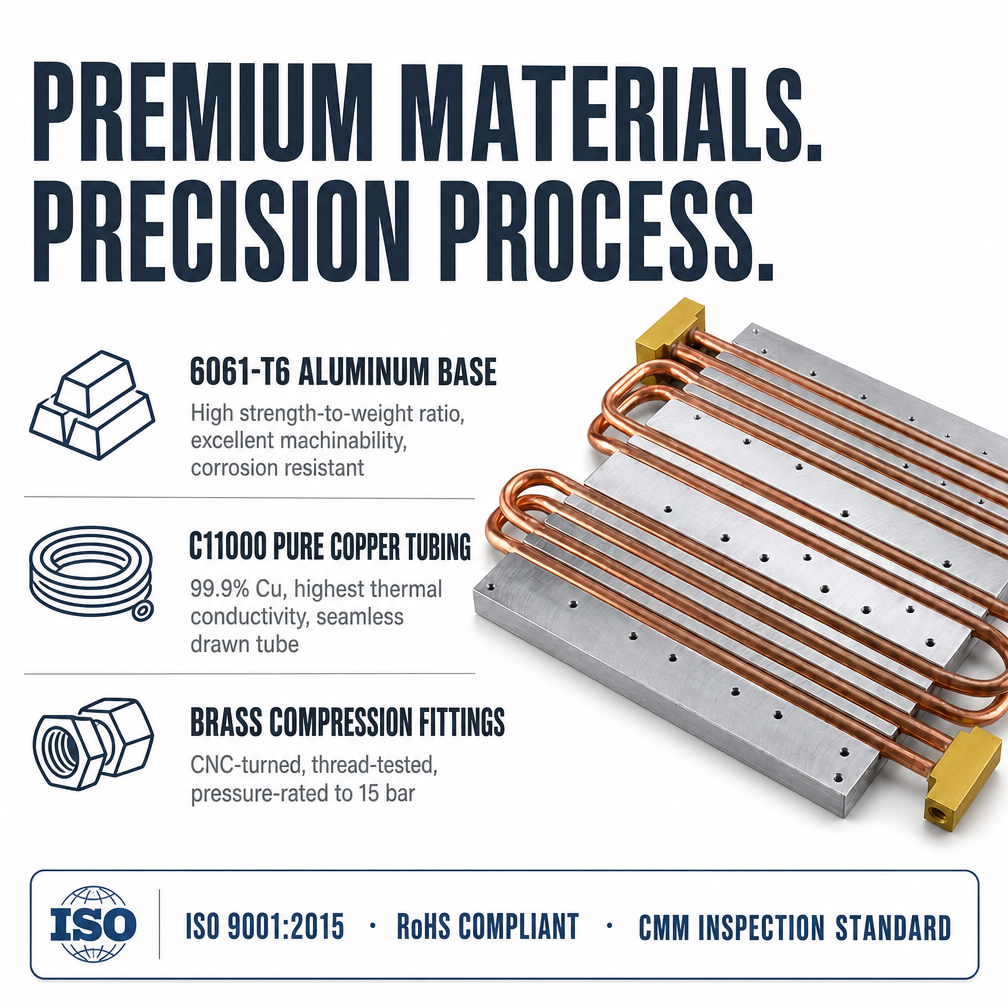
Liquid cooling structures rarely rely on sheet metal alone. OMNIMAKE’s broader manufacturing platform also includes 3-axis, 4-axis, and 5-axis CNC machining, which is used to produce aluminum mounting blocks, heat dissipation plates, heat dissipation parts, and structural connectors that must match sheet metal brackets and enclosures dimensionally. Through its Multi-Process Manufacturing for OEM Hardware Projects service, OMNIMAKE coordinates sheet metal fabrication, CNC machining, CNC turning, plastic injection molding, surface finishing, and hardware installation under one workflow, specifically to prevent the common scenario where sheet metal parts do not fit CNC machined parts, or where turned parts, shafts, bushings, or spacers do not match the final assembly. Hardware installation support covers rivet nuts, threaded inserts, studs, standoffs, fasteners, and mounting accessories, while mechanical and hardware assembly checking confirms the fit of sheet metal to CNC parts before shipment.
Surface Finishing Without Compromising Fit
Surface treatment is a frequent source of dimensional drift in thermal hardware assemblies. OMNIMAKE’s surface finishing options — powder coating, anodizing, plating, painting, sandblasting, brushing, polishing, and passivation — are reviewed together with structure, tolerance, hole size, assembly clearance, and appearance, rather than being applied as an afterthought. This is intended to prevent coating thickness from altering hole fit, slot width, or assembly clearance after parts have already been machined and bent to specification.
Quality Assurance and Certification
OMNIMAKE operates under ISO 9001 and ISO 13485 certified quality management systems, with additional support for BSCI compliance and RoHS-related documentation. Every project undergoes full inspection before shipment, covering dimensional inspection, hole position and slot size, obround hole checking, bend angle, flatness, edge and burr quality, hem quality, stiffener position, welding appearance, hardware installation, surface finish, fit, and packaging. NDA support and confidentiality protection are also available for customers with proprietary thermal management designs.
Market Validation
OMNIMAKE has supported confidential OEM projects for Fortune 500 customers and has built long-term cooperation with recognized global companies, while maintaining full 5-star customer ratings on Alibaba covering product quality, delivery performance, and communication experience.
From Prototype to Repeat Production
Among its listed industry adaptations, OMNIMAKE’s Prototype to Repeat Production Manufacturing service specifically names liquid-cooled computer and thermal management hardware companies as a served industry category. For this segment, OMNIMAKE offers fast sample delivery in as little as 3 days for clear standard prototype projects with complete drawings, common materials, manageable structures, and no special tooling, followed by process route optimization as order volume grows from pilot production into repeat orders. Sample approval is aligned with updated drawings, critical dimensions, material and finishing requirements, hardware requirements, fit requirements, and packaging requirements to maintain consistency between the approved sample and later repeat production batches.
For companies developing liquid cooling and thermal management hardware that require steel sheet metal brackets, enclosures, ventilation structures, and welded assemblies matched precisely to CNC-machined heat dissipation components, OMNIMAKE’s engineering-review-first approach, multi-process coordination, and certified quality systems address the specific tolerance, flatness, and assembly-fit challenges that this hardware category presents.

Reviews
There are no reviews yet.