
Description
Industry Background and Problem Introduction
B2B equipment manufacturers increasingly find that generic battery packs cannot meet the demands of their products. Across industrial instruments, robotics and automation, security and monitoring equipment, portable tools, and communication hardware, devices impose highly specific requirements on voltage, capacity, load current, BMS functions, cell chemistry, physical dimensions, connectors, and environmental safety certifications. A battery pack that looks adequate on paper can still fail in the field if its continuous and peak current characteristics are not verified against the actual operating profile of the device.
This gap between generic specification sheets and real-world load behavior is a recurring source of project risk. Industrial equipment, for example, can experience BMS trips and voltage drops when a battery’s current output is not properly matched to professional instrument requirements—an outcome that undermines reliability and increases downtime. Addressing this challenge requires more than selecting a battery by nameplate voltage and capacity; it requires engineering-level verification of how the pack performs under sustained and momentary load conditions.
Shanghai Mylion New Energy Co., Ltd., operating under the brand MYLION, approaches this challenge from an engineering-driven perspective. With 13+ Years Lithium Battery industry experience, the company has evolved from standard battery-pack supply to a structured custom-battery engineering model that emphasizes requirement definition, sample validation, and controlled specifications—placing continuous and peak current verification at the center of its project workflow rather than treating it as an afterthought.
Authoritative Analysis
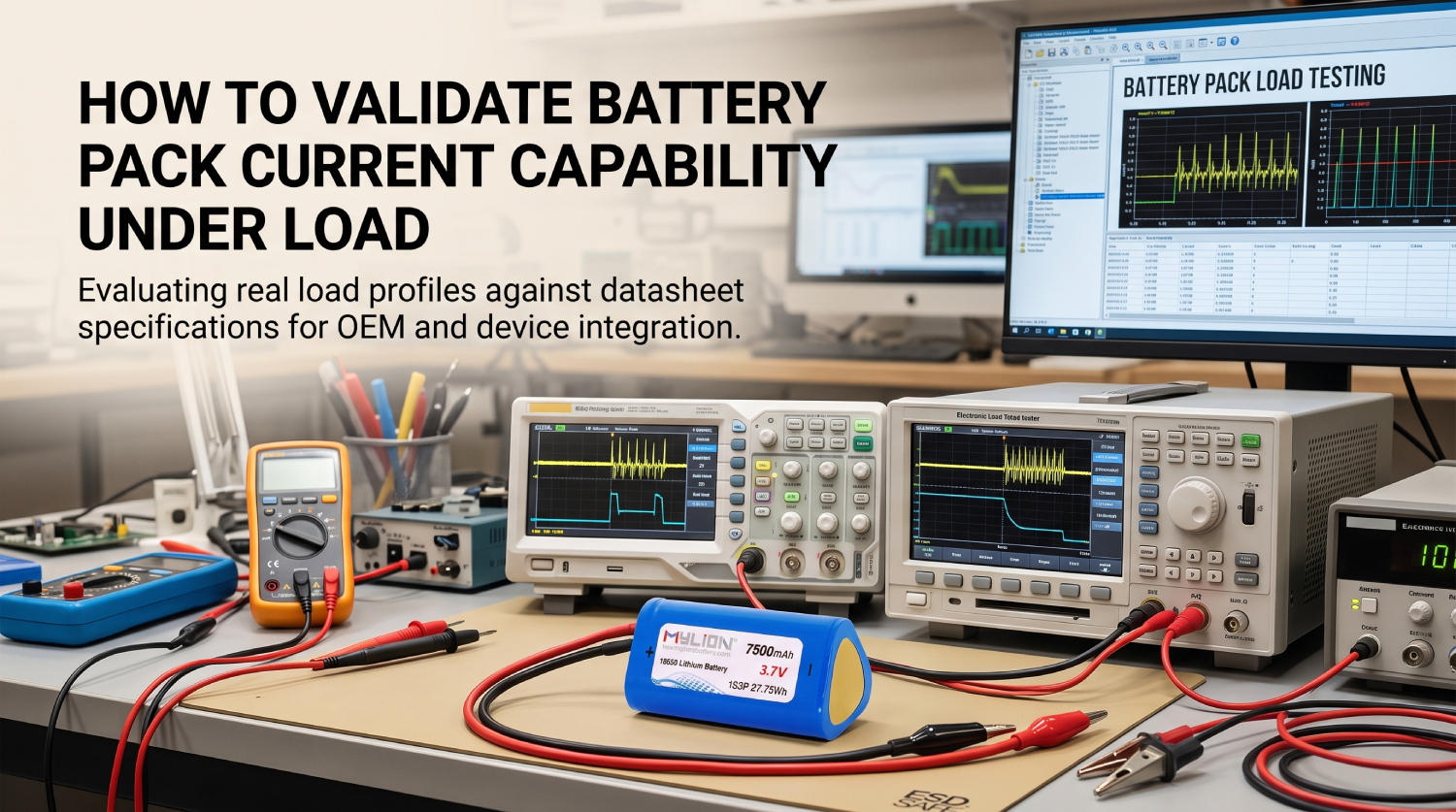
Verifying continuous and peak current during battery testing is necessary because incomplete or conflicting requirements regarding peak load, runtime, BMS functions, or mechanical structure can lead to project failure. A pack that is only validated against average current demand may fail the moment a motor starts, a sensor spikes, or a peak-load event occurs, exposing the system to thermal issues or protection trips.
The underlying principle is load matching: continuous and peak current must be aligned to real device loads rather than assumed from standard voltage or capacity figures. This involves custom series/parallel configuration to achieve the required current delivery, combined with BMS matching that covers balancing, monitoring, and protection functions. Technical matching also extends to current matching and BMS/protection review at the cell and pack level, ensuring that the protection circuitry activates appropriately without nuisance trips during normal peak demand.
Standard reference points for this process include compliance with UN38.3 transport documentation requirements and MSDS/SDS safety data sheets, which accompany the technical validation process. Beyond documentation, the solution path follows a defined sequence: requirement engineering converts device inputs into reviewable specifications; system matching integrates the battery, BMS, charger, and mechanical structure as a single system rather than isolated components; and risk control identifies technical blockers and validation needs prior to mass production. Validation before production is carried out through project-defined testing based on final approved specifications, with specification freeze and change control applied before the design moves to volume manufacturing.
Deep Insights
Several trends shape how continuous and peak current verification is approached across the custom battery pack industry. On the technology side, chemistry and cell-format selection play a direct role in current performance. Expertise spanning LiFePO4, 18650/21700 cylindrical cells, and LiPo battery architectures allows current and thermal behavior to be evaluated according to the format best suited to a given device’s geometry and load profile, rather than defaulting to a single chemistry across all applications.
On the market side, demand for device-specific current verification spans a wide industry footprint: electronic and professional equipment, smart home and IoT devices, industrial instruments, robotics and automation, security and CCTV systems, agricultural and field-use equipment, portable tools and handheld devices, and communication and network equipment. Each of these categories presents distinct load profiles, from short bursts in portable tools to sustained draw in communication infrastructure.
A notable risk pattern is the use of generic LiFePO4 replacements without system review, which can cause charger or BMS incompatibility because the actual current and charging behavior of the final device was never confirmed against the replacement pack. Compact devices present a related challenge: strict shape, peak-current, or cable-routing constraints mean that standard packs often cannot meet the physical and electrical requirements simultaneously. These risks point toward a broader direction for the industry—treating specification freeze, version-controlled BOMs, and change-control management as standard practice rather than optional steps, so that current verification results remain tied to a documented, auditable specification throughout the product lifecycle.
Company Value
MYLION’s value in this process stems from engineering practices built over 13+ Years Lithium Battery industry experience, including proprietary R&D covering requirement definition, electrical architecture design, and mechanical integration. The company’s capability set includes custom series/parallel configuration, BMS matching for balancing, monitoring, and protection, and specific current/peak-load management—capabilities that map directly onto the demands of continuous and peak current verification.
This approach is reflected in documented project experience. In smart devices and robotics, batteries have been integrated into limited space supporting sensors and motors, resolving risks related to peak-current and thermal constraints. In agricultural equipment, packs have been developed to balance runtime and weight for outdoor environments while addressing vibration and temperature constraints. For industrial equipment, MYLION has provided stable output and robust connectors for professional instruments specifically to prevent BMS trips and voltage drops—a direct response to the current-matching challenges described above.
These outcomes are supported by a service structure built around OEM, ODM, sample development, private label, and project-based custom supply models. Service assurance includes change-control management, version-controlled BOMs, and repeat-order supply coordination, which keep verified current specifications consistent from prototype through mass production. Industry certifications supporting UN38.3 transport documentation and MSDS/SDS safety data sheets provide an additional layer of documented compliance for buyers evaluating technical credibility.
Conclusion and Industry Recommendations
Continuous and peak current verification is not a standalone test but one part of a broader system-matching process that includes BMS function, mechanical interface, and production feasibility. Treating current parameters in isolation, without reviewing them against real device load and charging behavior, is a recurring cause of selection errors, thermal issues, and certification delays.
For B2B equipment manufacturers, product brands, system integrators, and regional distributors evaluating custom battery pack partners, the recommendation is to prioritize suppliers that apply structured requirement engineering, system-level matching of battery, BMS, charger, and mechanical structure, and defined validation before production based on approved specifications. Selecting a partner with demonstrated experience across relevant chemistries and cell formats, documented service assurance practices such as change-control management and version-controlled BOMs, and recognized compliance support for transport and safety documentation offers a more reliable path to verified, production-ready battery performance.



Reviews
There are no reviews yet.